
Introduction
Choosing between a pit vs pitless weighbridge — or a modular alternative — is one of the most important decisions for businesses that rely on accurate vehicle weighing. Industries such as logistics, mining, construction, agriculture, manufacturing, recycling, and warehousing use weighbridges every day to monitor incoming and outgoing materials. However, choosing between different weighbridge designs can be confusing if you do not understand their differences.
Among the most popular options available today are pit weighbridges, pitless weighbridges, and modular weighbridges. Each design offers unique advantages, installation requirements, maintenance needs, and long-term operating costs. As a result, selecting the wrong type can increase installation expenses, reduce efficiency, or make future expansion difficult.
This comprehensive guide compares pit vs pitless weighbridge designs (plus modular systems) in detail, according to OIML international weighing standards and general legal metrology guidelines in India. By the end of this article, you will understand which option suits your business, budget, and available space.
What is a Weighbridge?
A weighbridge is a heavy-duty industrial weighing system designed to measure the weight of loaded and unloaded trucks accurately. Businesses use the weight difference to determine the quantity of transported goods.
Generally, a complete weighbridge system includes:
- Steel or concrete platform
- High-precision load cells
- Junction box
- Digital weight indicator
- Weighbridge software
- Foundation structure
Although the weighing technology remains similar across different models, the platform design and installation method vary significantly.
Understanding the Three Main Types of Weighbridges
Before comparing them, let’s understand each design individually.
Pit Weighbridge
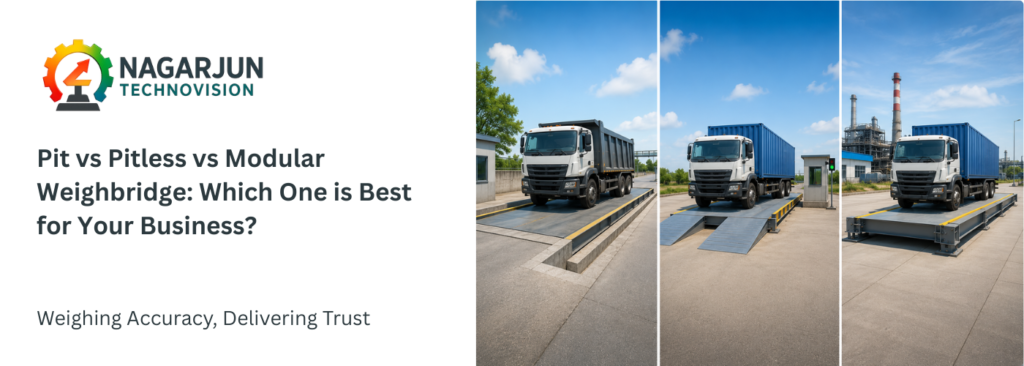
A pit weighbridge sits inside a concrete pit, allowing the platform surface to remain level with the surrounding road. Because there are no approach ramps, vehicles can enter from any direction. Overall, this traditional design is widely used where available space is limited.
Common Applications
- Industrial plants
- Urban factories
- Warehouses
- Cement plants
- Food processing units
Advantages
- Requires less surface area
- Vehicles can approach from all directions
- Cleaner appearance
- Better traffic management
- Suitable for locations with limited space
Disadvantages
- Higher civil construction cost
- Water drainage requires careful planning
- Pit cleaning increases maintenance
- Repairs take more time
- Foundation construction is more complex
Pitless Weighbridge
A pitless weighbridge is installed above ground using RCC foundations. Vehicles access the platform through approach ramps located at both ends. Today, pitless models have become one of the most popular choices across India because installation is relatively simple.
Common Applications
- Logistics companies
- Mining
- Agriculture
- Construction sites
- Manufacturing plants
Advantages
- Lower civil construction cost
- Easy inspection of load cells
- Better ventilation
- Simple maintenance
- Faster installation
Disadvantages
- Requires additional land
- Ramps occupy extra space
- Side impacts from vehicles can occur if drivers are careless
- Aesthetics may not suit all locations
Modular Weighbridge
A modular weighbridge consists of prefabricated steel modules manufactured in a factory and assembled at the installation site. Consequently, the modular construction significantly reduces installation time while allowing future expansion. Because of this flexibility, many industries now prefer modular weighbridges.
Common Applications
- Temporary project sites
- Mining operations
- Infrastructure projects
- Large logistics parks
- Multi-location businesses
Advantages
- Extremely fast installation
- Factory-built precision
- Easy transportation
- Expandable design
- Simple relocation
- Minimal site work
Disadvantages
- Higher initial equipment cost
- Transportation charges depend on location
- Skilled installation team required
- Customization options may be limited
Pit vs Pitless vs Modular Weighbridge: Comparison Table
| Feature | Pit Weighbridge | Pitless Weighbridge | Modular Weighbridge |
|---|---|---|---|
| Installation | Inside pit | Above ground | Modular sections |
| Construction Cost | High | Moderate | Moderate |
| Installation Time | Long | Short | Very Short |
| Maintenance | Moderate | Easy | Easy |
| Drainage Requirement | High | Low | Low |
| Space Requirement | Less | More | Moderate |
| Vehicle Access | Multiple directions | Two directions | Depends on layout |
| Relocation | Difficult | Difficult | Easy |
| Future Expansion | Limited | Limited | Excellent |
| Best For | Limited space | General industries | Growing businesses |
Installation Comparison
Installation plays a major role in deciding the total project cost.
Pit Weighbridge Installation: Pit weighbridges require extensive excavation, reinforced concrete work, waterproofing, and drainage planning. Consequently, installation may take several weeks depending on soil conditions.
Pitless Weighbridge Installation: Pitless systems require RCC foundations along with approach ramps. Since excavation is minimal, installation finishes much faster than with pit weighbridges.
Modular Weighbridge Installation: Modular systems arrive as ready-made sections. Workers simply assemble the modules on prepared foundations, so installation often finishes within just a few days.
Cost Comparison
Cost is another important factor when comparing Pit vs Pitless vs Modular Weighbridge.
| Cost Factor | Pit | Pitless | Modular |
|---|---|---|---|
| Civil Construction | Highest | Medium | Lowest |
| Equipment Cost | Medium | Medium | Highest |
| Installation Cost | High | Medium | Low |
| Maintenance Cost | Medium to High | Low | Low |
| Relocation Cost | Very High | Medium | Low |
Which Option is Most Affordable?
- The pit weighbridge has the highest construction cost.
- Meanwhile, the pitless weighbridge offers the best balance of price and performance.
- On the other hand, the modular weighbridge has a higher purchase price but reduces installation and relocation costs.
Maintenance Comparison
Regular maintenance ensures long-term weighing accuracy, and following general industrial equipment maintenance best practices helps extend service life.
Pit Weighbridge: Because the load cells remain inside a pit, technicians must inspect drainage systems frequently. If cleaning is ignored, water accumulation, mud, and debris can affect maintenance schedules.
Pitless Weighbridge: Since technicians can easily access all components underneath the platform, inspections take less time and repairs become easier.
Modular Weighbridge: Similarly, modular systems provide excellent accessibility. Furthermore, replacing damaged sections becomes easier because the platform consists of separate modules.
Durability Comparison
Modern weighbridges use high-strength structural steel and precision load cells. However, durability ultimately depends on installation quality and maintenance.
Pit Weighbridge
- Excellent structural stability
- Protected from side vehicle impact
- Long service life with proper drainage
Pitless Weighbridge
- Durable steel structure
- Better ventilation reduces corrosion
- Performs well in various weather conditions
Modular Weighbridge
- Factory-controlled manufacturing improves quality
- Easy replacement of individual modules
- Designed for heavy industrial applications
Space Requirements
Available land often determines which weighbridge suits your facility.
Choose a Pit Weighbridge if:
- Land is limited
- Vehicles require multi-direction access
- The site has sufficient drainage planning
Choose a Pitless Weighbridge if:
- Land is available
- You want easier maintenance
- Construction cost is important
Choose a Modular Weighbridge if:
- Future expansion is expected
- Installation speed matters
- Business locations may change
Which Industries Use Each Type?
Pit Weighbridge: Food processing, chemical plants, cement industries, and urban manufacturing.
Pitless Weighbridge: Logistics, warehousing, agriculture, steel plants, and recycling.
Modular Weighbridge: Mining, infrastructure projects, construction, temporary industrial sites, and large logistics hubs.
Factors to Consider Before Buying
Every business has different operational requirements. Therefore, evaluate the following factors before purchasing a weighbridge.
- Available Land: Limited land generally favors pit weighbridges, whereas open industrial sites usually accommodate pitless systems.
- Budget: Include civil construction, transportation, installation, maintenance, and future repairs while calculating the total investment.
- Vehicle Traffic: High vehicle movement may benefit from pit weighbridges since vehicles can enter from multiple directions.
- Future Expansion: Businesses planning capacity growth should consider modular weighbridges, as additional modules can simplify upgrades.
- Maintenance Capability: If easy servicing is a priority, pitless and modular weighbridges offer better accessibility.
- Drainage Conditions: Areas with frequent rainfall require effective drainage, especially for pit weighbridges.
Which Weighbridge is Best for Indian Industries?
- Manufacturing Plants: A pitless weighbridge works well because of its low maintenance and quick installation.
- Mining Industry: Heavy-duty pitless or modular weighbridges are preferred due to easier servicing under harsh operating conditions.
- Logistics Companies: Modular weighbridges are ideal since they can be relocated as logistics hubs expand.
- Construction Sites: Temporary construction sites benefit from modular weighbridges that can be dismantled and reused elsewhere.
- Agricultural Businesses: Pitless weighbridges offer excellent value with lower installation costs and reliable performance.
- Industrial Areas with Limited Land: Pit weighbridges remain the best choice where available space is restricted.
Which Weighbridge Should You Choose?
Before making your final decision, evaluate your available space, budget, maintenance requirements, and future expansion plans.
A pit weighbridge works best when land is limited or vehicles need to approach the platform from multiple directions. Although the initial civil work costs more, it saves valuable surface space.
If easy maintenance and lower installation costs matter most, a pitless weighbridge is an excellent option. Moreover, technicians can inspect and service its components quickly because they remain easily accessible.
For businesses planning future growth, a modular weighbridge offers the greatest flexibility. Since you can relocate, expand, or reinstall the system with minimal disruption, many logistics companies, mining operations, and temporary industrial sites prefer modular weighbridges for long-term value.
Ultimately, the best weighbridge depends on your operational requirements rather than a single feature. So, comparing installation costs, maintenance needs, available land, and future business plans will help you make the right investment.
Why Buy Your Weighbridge from RudrMart?
At RudrMart, we provide reliable weighing solutions designed for industrial applications across India. Our offerings include:
- Electronic weighbridges
- Digital load cells
- Indicator systems
- Junction boxes
- Weighbridge accessories
- Installation support
- Calibration assistance
- Annual Maintenance Contracts (AMC)
In addition, our experts help businesses select the right weighbridge based on operational needs, available space, and budget.
Conclusion
Choosing between Pit vs Pitless vs Modular Weighbridge requires careful evaluation of your available land, project budget, maintenance capability, and future expansion plans.
If your facility has limited space, a pit weighbridge remains an excellent solution. On the other hand, a pitless weighbridge offers the best balance between affordability and ease of maintenance, making it suitable for most Indian industries. Meanwhile, a modular weighbridge provides unmatched flexibility, rapid installation, and convenient relocation for growing businesses.
Instead of focusing only on the initial purchase price, consider the total ownership cost over the weighbridge’s entire lifespan. Ultimately, a well-planned investment today can improve operational efficiency, reduce maintenance expenses, and ensure accurate weighing for many years.
Frequently Asked Questions (FAQs)
1. Which weighbridge is cheaper to install?
Pitless weighbridges generally have lower installation costs because they require less civil construction than pit-type weighbridges.
2. Is a modular weighbridge permanent?
Yes. A modular weighbridge can be used as a permanent installation while also offering the flexibility to relocate or expand in the future.
3. Which weighbridge requires the least maintenance?
Pitless and modular weighbridges usually require less maintenance since their components are easily accessible.
4. Which weighbridge is suitable for small industrial plots?
A pit weighbridge is ideal when land availability is limited.
5. Can a modular weighbridge be relocated?
Yes. One of the biggest advantages of a modular weighbridge is that it can be dismantled, transported, and reinstalled at another location.