
Introduction
Modern highways carry thousands of vehicles every day, ranging from passenger cars and light commercial vehicles to heavily loaded multi-axle trucks. Therefore, highway operators need more than basic vehicle detection. They also need accurate information about vehicle weight, axle configuration, speed, and classification.
For example, operators may need to know how many axles a truck has, how much weight each axle carries, and whether the vehicle exceeds a configured weight limit. In addition, they may need to identify the vehicle and connect its data with ANPR or a Traffic Management System (TMS).
This is where overload detection with WIM becomes valuable.
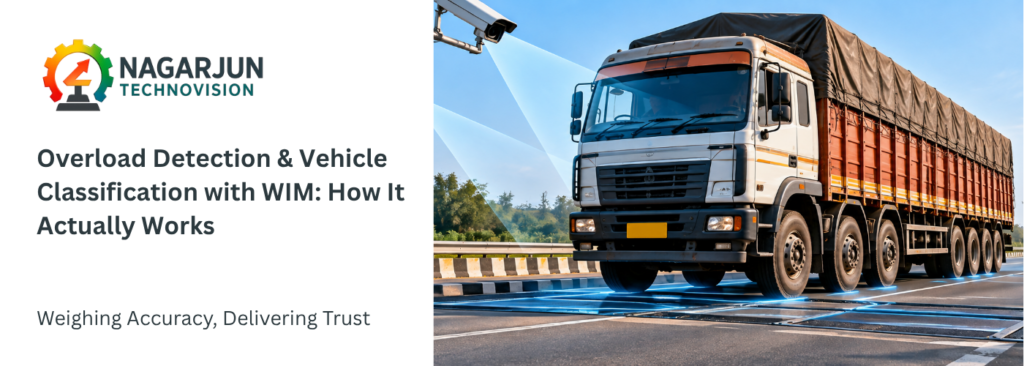
A Weigh-in-Motion (WIM) system measures vehicle weight while the vehicle is moving. At the same time, it can combine weighing data with axle detection, vehicle classification, and identification technologies. As a result, highway operators can monitor traffic without stopping every vehicle on a conventional static weighbridge.
So, how does the complete process work? Let’s follow a vehicle through a WIM system step by step.
What Is a Weigh-in-Motion (WIM) System?
A Weigh-in-Motion system measures the dynamic forces produced by vehicle wheels or axles while a vehicle travels over weighing sensors installed in the road.
After capturing these signals, the WIM electronics and software process them to determine useful vehicle information.
Depending on the system configuration, WIM can measure or calculate:
- Individual axle load
- Axle-group load
- Gross Vehicle Weight (GVW)
- Number of axles
- Axle spacing
- Vehicle speed
- Vehicle presence or length
- Vehicle class
- Overload status
Furthermore, WIM solutions can be designed for different vehicle speeds and applications. Common configurations include Slow-Speed WIM (SSWIM), Medium-Speed WIM (MSWIM), and High-Speed WIM (HS-WIM).
Although their operating conditions differ, the basic objective remains similar: measure and analyze vehicle weight while traffic remains in motion.
How Does WIM Actually Work?
The easiest way to understand the process is to follow a truck as it passes through a WIM-equipped lane.
Step 1: The Vehicle Enters the Detection Zone
First, the vehicle approaches the WIM measurement area. A vehicle-detection device then identifies its presence.
Depending on the system architecture, detection technologies may include:
- Vehicle separators
- Light curtains
- Inductive loops
- Photoelectric sensors
- Radar or other vehicle detectors
These devices help determine when a vehicle enters and exits the measurement zone.
More importantly, accurate vehicle separation helps the system associate axle and weight measurements with the correct vehicle. This becomes especially useful when multiple vehicles travel close together.
Step 2: Each Axle Passes Over the WIM Sensors
Next, each axle passes over weighing sensors installed across the traffic lane.
One commonly used WIM technology is the bending plate sensor.
When a wheel applies force to the bending plate, the sensor structure undergoes a very small mechanical deformation. Strain gauges respond to this deformation and convert it into an electrical signal.
The basic process is:
Wheel Load → Mechanical Strain → Electrical Signal → Signal Processing → Weight Data
However, a moving vehicle does not create the same stable measurement conditions as a stationary vehicle. Therefore, the WIM system must process dynamic signals generated while each axle crosses the sensor.
Step 3: The WIM Indicator Processes the Signal
Afterward, electrical signals from the weighing sensors are transmitted to the WIM indicator or controller.
The electronics amplify, filter, and process these signals. Then, using calibration parameters and signal-processing algorithms, the system converts them into axle-weight information.
Several factors can influence dynamic weighing. For example, vehicle speed, suspension movement, road condition, acceleration, braking, sensor installation, and calibration can all affect the forces measured at the road surface.
Therefore, reliable WIM performance depends on more than the sensor alone. Proper civil installation, road condition, electronics, calibration, and software are equally important.
How WIM Calculates Axle Weight
Consider a five-axle truck travelling through a WIM lane.
As each axle crosses the weighing sensors, the system records its measured load individually.
For example:
| Axle | Measured Load |
|---|---|
| Axle 1 | 6,200 kg |
| Axle 2 | 9,100 kg |
| Axle 3 | 9,300 kg |
| Axle 4 | 9,200 kg |
| Axle 5 | 9,000 kg |
| Measured GVW | 42,800 kg |
Once all axles have crossed the measurement zone, the system adds their measured loads.
Therefore:
GVW = Axle 1 + Axle 2 + Axle 3 + Axle 4 + Axle 5
In this example, the calculated Gross Vehicle Weight is 42,800 kg.
Consequently, the system now has both axle-level weight information and the vehicle’s total measured weight.
How Does WIM Detect an Overloaded Vehicle?
Measuring weight is only the first stage of overload detection.
Next, the WIM software compares the measured axle loads and GVW with the configured weight criteria for the application.
The process can be represented as:
Measured Vehicle Data → Configured Weight Criteria → Comparison → Overload Status
For example:
Measured GVW: 42,800 kg
Configured Limit: 40,000 kg
Therefore:
Overload = 42,800 − 40,000 = 2,800 kg
The overload percentage is:
(2,800 ÷ 40,000) × 100 = 7%
As a result, the system can flag the vehicle as exceeding the configured limit.
However, actual permissible limits depend on applicable regulations, axle configuration, vehicle category, and project requirements. Therefore, these values must be configured according to the intended application and relevant regulatory framework.
WIM Can Detect More Than Total Vehicle Overloading
A major advantage of overload detection with WIM is its ability to provide axle-level information.
For instance, a vehicle may remain within a total GVW threshold while placing excessive load on one axle or axle group. Therefore, monitoring only total vehicle weight may not provide the complete picture.
Depending on the WIM configuration, the system can evaluate:
Individual Axle Load
The software can compare each measured axle load with the applicable configured threshold.
Axle-Group Load
Similarly, tandem, tridem, or other axle groups can be evaluated where required.
Gross Vehicle Weight
Finally, the combined axle measurements provide the vehicle’s calculated GVW.
Consequently, WIM provides a more detailed view of vehicle loading than a simple total-weight measurement alone.
How Vehicle Classification Works with WIM
Besides weighing vehicles, an integrated WIM system can support automatic vehicle classification.
Instead of simply recording that a vehicle passed the measurement point, the system can identify characteristics such as the number of axles and their spacing.
For example, a record may indicate that a five-axle heavy vehicle has passed through the lane.
Depending on the project, classification can use a combination of:
- Number of axles
- Axle spacing
- Vehicle length
- Vehicle speed
- Vehicle presence profile
- Weight characteristics
- External classification sensor data
Therefore, vehicle classification becomes more reliable when multiple data points are analyzed together.
1. Axle Count
First, the system counts the axles as they cross the detection and weighing zone.
For example, it may detect:
- 2-axle vehicle
- 3-axle vehicle
- 4-axle vehicle
- 5-axle vehicle
- 6-axle vehicle
Axle count helps narrow down the possible vehicle category. However, axle count alone may not always provide enough information.
Therefore, additional parameters can also be analyzed.
2. Axle Spacing
Next, the system can analyze the time interval between consecutive axle detections.
When vehicle speed is known, this timing information can be used to estimate axle spacing.
In simplified form:
Axle Spacing = Vehicle Speed × Time Between Axle Detections
As a result, the axle pattern can help distinguish between vehicles that have the same number of axles but different configurations.
3. Vehicle Length and Profile
In addition, suitable detection equipment can provide information about vehicle length or profile.
For example, a vehicle separator or other detection arrangement can help identify:
- Start of vehicle
- End of vehicle
- Vehicle separation
- Approximate vehicle length
- Closely spaced vehicles
Consequently, these additional measurements can improve vehicle classification, especially in mixed traffic conditions.
4. Weight Pattern
WIM becomes even more useful when integrated with Automatic Number Plate Recognition (ANPR).
In simple terms:
WIM determines: What are the vehicle’s weight and axle characteristics?
ANPR determines: Which vehicle is it?
When these systems are properly synchronized, the platform can create a combined vehicle record.
For example:
| Parameter | Example |
|---|---|
| Registration Number | DL01XX0000 |
| Vehicle Class | Multi-Axle Vehicle |
| Number of Axles | 5 |
| Speed | 48 km/h |
| Axle 1 | 6,200 kg |
| Axle 2 | 9,100 kg |
| Axle 3 | 9,300 kg |
| Axle 4 | 9,200 kg |
| Axle 5 | 9,000 kg |
| GVW | 42,800 kg |
| Overload | 2,800 kg |
| Overload Percentage | 7% |
| Status | Overload Flag |
The registration number shown above is only an illustrative example.
Additionally, the system may associate the record with a vehicle image, lane number, timestamp, transaction ID, and other project-specific information.
WIM + Vehicle Classification + ANPR
The registration number above is only an illustrative example.
Depending on the project architecture, additional information such as timestamp, lane number, vehicle image and transaction ID may also be associated with the record.
Complete WIM Data Flow
A typical integrated process can be represented as:
Vehicle Approaches
↓
Vehicle Detection
↓
Axles Cross WIM Sensors
↓
Dynamic Sensor Signals Generated
↓
WIM Indicator Processes Signals
↓
Axle Loads Calculated
↓
GVW Calculated
↓
Axle Count & Spacing Determined
↓
Vehicle Classified
↓
Configured Weight Limits Checked
↓
Normal / Overload Status Generated
↓
ANPR Identifies Vehicle
↓
Vehicle + Weight + Classification Data Combined
↓
Data Sent to TMS / Control Room / Enforcement Application
The entire sequence can occur automatically while the vehicle continues through the monitored lane, subject to the particular WIM configuration.
Role of WIM in Overload Pre-Screening
One of the most valuable applications of WIM is overload pre-screening.
A busy highway may carry thousands of commercial vehicles every day. Stopping every truck for static weighing can increase queues, processing time, and operational requirements.
WIM offers a different approach.
First, vehicles pass through the WIM measurement zone. Next, the system measures their axle loads and GVW. Vehicles within the configured criteria can continue according to the project’s operating process.
Meanwhile, a potentially overloaded vehicle can be flagged for further action.
In simplified form:
Normal Vehicle → Continue
Potentially Overloaded Vehicle → Flag for Further Inspection or Verification
Where required, a vehicle identified during WIM pre-screening can be diverted to an approved static weighing system or another authorized verification process.
As a result, operators can focus resources on vehicles that require attention instead of stopping the entire traffic stream.
WIM for Toll Plazas and Highway Operations
WIM data can also become part of a larger Intelligent Transportation System (ITS).
For example, the WIM platform may integrate with:
- Toll Management System (TMS)
- ANPR
- Automatic Vehicle Classification (AVC)
- Vehicle Management System
- Variable Message Signs (VMS)
- Traffic signals
- Boom barriers
- Lane controllers
- Central control rooms
- Highway monitoring software
- Overload management systems
Therefore, WIM does not have to operate as an isolated weighing system.
Instead, weight and classification data can become part of the wider highway-management ecosystem.
For example, when the system detects a potentially overloaded vehicle, it can generate an event for the monitoring software or lane-control system. The subsequent action will depend on the project’s operational requirements and applicable regulations.
SSWIM, MSWIM and HS-WIM: What’s the Difference?
Different highway applications require different WIM configurations.
Therefore, WIM systems are commonly categorized according to their intended operating conditions and vehicle speeds.
Slow-Speed Weigh-in-Motion (SSWIM)
SSWIM is generally used where vehicles move through a controlled lane at relatively low speeds.
Typical applications may include:
- Toll plazas
- Industrial facilities
- Check posts
- Logistics facilities
- Controlled highway lanes
Because vehicle movement is controlled, the weighing environment can be easier to manage than normal highway-speed traffic.
Medium-Speed Weigh-in-Motion (MSWIM)
MSWIM is designed for applications where vehicles pass through the measurement zone at higher speeds than slow-speed WIM.
Potential applications include:
- Highway lanes
- Overload screening
- Toll-road applications
- Traffic monitoring
- Controlled enforcement environments
Therefore, MSWIM can provide a balance between traffic movement and dynamic weight measurement for suitable applications.
High-Speed Weigh-in-Motion (HS-WIM)
HS-WIM is designed to capture vehicle weight information while vehicles travel at higher or highway operating speeds, depending on the system design and project conditions.
Potential applications include:
- Continuous highway traffic monitoring
- Overload pre-screening
- Freight analysis
- Highway planning
- Pavement studies
- Traffic data collection
- Smart highway infrastructure
However, high-speed weighing places greater importance on pavement quality, sensor installation, calibration, signal processing, and vehicle dynamics.
Therefore, the complete installation environment plays a major role in HS-WIM performance.
Why Does Road Condition Matter for WIM?
The weighing sensor is only one part of a WIM installation.
When a truck travels over an uneven road surface, its suspension moves vertically. Consequently, the instantaneous wheel force applied to the road can change.
For this reason, pavement condition around the weighing zone is important for dynamic weighing performance.
Key installation considerations include:
- Pavement smoothness
- Sensor alignment
- Sensor foundation
- Lane geometry
- Drainage
- Road approach condition
- Civil foundation quality
Therefore, good WIM performance starts with proper site selection and civil installation, not just the weighing electronics.
Why Is WIM Calibration Important?
Calibration is another critical part of WIM performance.
During calibration, WIM measurements are compared with known or reference vehicle weights. The system parameters can then be adjusted according to the required measurement performance.
Depending on the application, calibration may consider:
- Reference axle loads
- Gross Vehicle Weight
- Vehicle speed
- Different vehicle configurations
- Multiple vehicle runs
- Lane-specific behaviour
Moreover, calibration may need to be reviewed after major civil work, sensor replacement, or other changes that could influence measurement performance.
Therefore, calibration should be considered an essential part of installation and maintenance.
What Can Affect WIM Measurement Performance?
Several factors can influence dynamic weighing results.
These include:
Vehicle Speed
Large variations from the system’s intended operating conditions may influence measurement performance.
Acceleration and Braking
Vehicles accelerating or braking sharply inside the weighing zone can alter dynamic wheel forces.
Road Surface
Uneven pavement can introduce additional vehicle movement and dynamic loading.
Sensor Installation
Incorrect installation, poor alignment or foundation issues can affect sensor response.
Calibration
Poor or outdated calibration can introduce systematic measurement errors.
Vehicle Suspension
Different suspension systems respond differently to road conditions.
Environmental Conditions
Temperature, moisture, drainage and other environmental factors need to be considered during system and civil design.
This is why a professional WIM installation is not simply a matter of placing a weighing sensor in the road.
WIM vs Static Weighbridge
A static weighbridge and a WIM system serve related but different purposes.
| Feature | WIM | Static Weighbridge |
|---|---|---|
| Vehicle movement | Vehicle remains in motion | Vehicle normally stops |
| Traffic throughput | High | Lower |
| Continuous screening | Excellent | Limited |
| Axle information | Available depending on configuration | Depends on weighbridge arrangement |
| Overload pre-screening | Highly suitable | Not primary purpose |
| Highway traffic monitoring | Highly suitable | Less suitable |
| Verification/enforcement | Depends on approval and application | Commonly used where certified static weighing is required |
The two technologies can therefore complement each other.
A WIM installation can identify vehicles that require attention, while an approved static weighing system can be used where formal verification is required.
Benefits of WIM-Based Overload Detection
Implementing WIM for overload detection and vehicle classification can provide several operational benefits.
1. Continuous Vehicle Monitoring
Vehicles can be monitored automatically without manually weighing every vehicle.
2. Higher Traffic Throughput
Because vehicles do not necessarily need to stop for initial screening, traffic disruption can be reduced.
3. Axle-Level Information
Operators can obtain individual axle loads in addition to total vehicle weight.
4. Automatic Vehicle Classification
Vehicle class can be determined using axle and other vehicle characteristics.
5. Overload Pre-Screening
Potentially overloaded vehicles can be identified for further inspection or verification.
6. ANPR Integration
Weight records can be associated with vehicle identification information.
7. Centralized Monitoring
Data can be transferred to traffic management software or control rooms.
8. Better Traffic Data
WIM can provide valuable information about commercial traffic patterns, vehicle classes and loading behaviour.
9. Infrastructure Planning
Aggregated axle-load and traffic data can support pavement studies, maintenance planning and highway asset management.
WIM and Smart Highway Infrastructure
The future of WIM goes beyond simply displaying vehicle weight on an indicator.
An integrated highway ecosystem can combine:
WIM + ANPR + Vehicle Classification + Traffic Management + Central Monitoring
For each vehicle, the system can potentially create a digital record containing:
- Vehicle identity
- Vehicle image
- Vehicle class
- Axle count
- Axle spacing
- Individual axle loads
- Gross Vehicle Weight
- Speed
- Overload status
- Lane
- Date and time
This creates a valuable real-time data layer for highway operations.
As India’s highway infrastructure becomes increasingly digital, integrated WIM systems can support data-driven traffic management, overload screening and intelligent transportation applications.
WIM Solutions from Nagarjun Technovision
Nagarjun Technovision Pvt. Ltd. provides Weigh-in-Motion and vehicle weighing solutions for highway, tolling and industrial applications.
Our WIM portfolio includes:
- Slow-Speed Weigh-in-Motion (SSWIM)
- Medium-Speed Weigh-in-Motion (MSWIM)
- High-Speed Weigh-in-Motion (HS-WIM)
- Bending Plate Sensors
- WIM Indicators and Controllers
- Vehicle Detection and Separation Systems
- Static Weighbridges
- Axle Weighing Solutions
- ANPR and TMS Integration
- Installation and Commissioning
- Calibration Support
- Preventive Maintenance and AMC Support
Our solutions are developed with a focus on the requirements of Indian highway and operating conditions, with engineering, integration and service support for projects across India.
Nagarjun Technovision Pvt. Ltd. — Weighing Accuracy, Delivering Trust.
Conclusion
A modern Weigh-in-Motion system does much more than weigh a moving truck.
It creates a sequence of connected measurements:
Detect the Vehicle → Detect the Axles → Measure Dynamic Loads → Calculate Axle Weight → Calculate GVW → Determine Vehicle Class → Check Overload → Identify the Vehicle → Send Data to the Management System
When WIM is combined with vehicle classification, ANPR and Traffic Management Systems, highway operators can transform a simple weighing point into an intelligent vehicle-monitoring system.
For highway authorities, toll operators, logistics facilities and infrastructure developers, this can enable faster overload screening, better traffic data and more efficient vehicle monitoring while minimizing unnecessary interruption to traffic flow.
Frequently Asked Questions
1. What is overload detection using WIM?
Overload detection using WIM involves measuring axle loads and Gross Vehicle Weight while a vehicle is moving and comparing the measured values with configured permissible weight limits. Vehicles exceeding the relevant threshold can then be flagged for further action.
2. Can WIM detect individual axle weight?
Yes. Depending on the sensor and system configuration, WIM can measure individual axle loads and calculate axle-group loads and total Gross Vehicle Weight.
3. Can WIM identify the type of vehicle?
Yes. Vehicle classification can use axle count, axle spacing, vehicle dimensions, weight information and data from additional classification sensors to determine the vehicle category.
4. Does a vehicle have to stop on a WIM system?
No. The primary purpose of WIM is to measure vehicle weight while the vehicle is moving. The permitted operating speed depends on whether the installation is designed as SSWIM, MSWIM or HS-WIM.
5. Can WIM detect overloaded trucks automatically?
Yes. The system can automatically compare measured axle loads and GVW with configured limits and generate an overload flag. Whether that measurement can be used directly for legal enforcement depends on the applicable approval, metrology and regulatory requirements.
6. Can WIM be integrated with ANPR?
Yes. ANPR integration allows the system to associate weight and classification information with a detected vehicle registration number, subject to the project’s integration architecture.
7. What is the difference between WIM and a weighbridge?
A conventional weighbridge generally weighs a stationary vehicle, whereas WIM measures vehicle weight while the vehicle is moving. WIM is particularly useful for continuous traffic monitoring and overload pre-screening.
8. What is HS-WIM?
High-Speed Weigh-in-Motion, or HS-WIM, is designed to measure vehicle weight information while traffic travels at higher or normal highway speeds, subject to system design and operating conditions.
9. Why is calibration important for WIM?
Calibration establishes the relationship between sensor signals and known reference weights. Proper calibration is essential for achieving reliable axle-load and GVW measurements.
10. Can WIM integrate with a Toll Management System?
Yes. WIM data can be integrated with Toll Management Systems and other ITS platforms through suitable interfaces or APIs, allowing weight, classification and overload information to be used within a broader highway-management system.