
Introduction
India Highway Infrastructure Evolution is transforming transportation across the country. From manual toll booths and cash payments to FASTag, MLFF tolling, smart highways, AI traffic systems, and future mobility technologies, India is rapidly building a faster, smarter, and more connected highway ecosystem designed for efficiency, safety, and sustainable transportation.
India’s transportation network is witnessing one of the most significant infrastructure transformations in its history. From long queues at manual toll plazas to the rise of AI-powered smart highways, the country is rapidly moving toward a future driven by automation, intelligent mobility, and digital infrastructure.
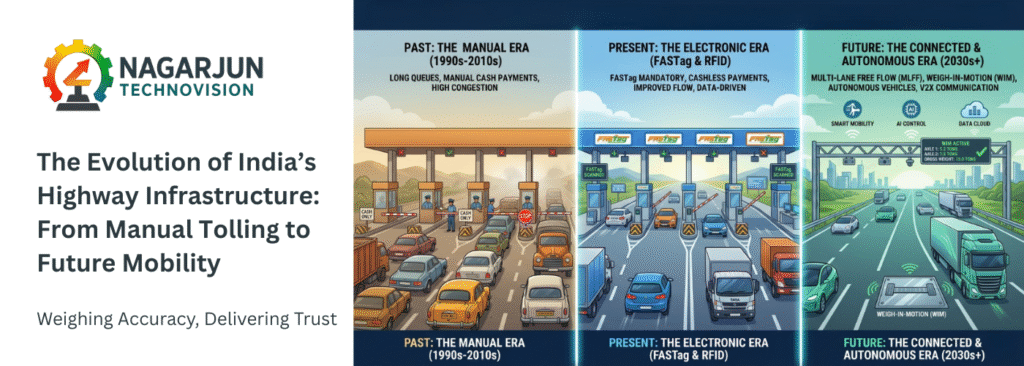
Over the years, India’s highway ecosystem has evolved from traditional road systems into technology-enabled transportation corridors designed to improve efficiency, safety, and connectivity. The progression from Manual Tolling → FASTag → MLFF → Smart Highways → AI Traffic Systems → Future Mobility reflects the nation’s commitment to building smarter and more sustainable transportation networks.
Today, highways are no longer just roads connecting cities — they are becoming intelligent systems capable of real-time communication, automated monitoring, predictive traffic management, and seamless mobility experiences.
The Era of Manual Tolling
For decades, toll collection across Indian highways relied entirely on manual operations. Vehicles had to stop at toll plazas, pay cash, collect printed receipts, and wait for barriers to open before continuing their journey.
While this system worked during periods of lower traffic density, it became increasingly inefficient as vehicle numbers grew rapidly across the country.
Manual tolling created several operational challenges:
- Long queues at toll plazas
- Increased travel delays
- Fuel wastage from idling vehicles
- Higher air pollution near toll booths
- Revenue leakages and operational inefficiencies
- Slower freight and logistics movement
Commercial transport vehicles were especially affected, as delays at toll plazas increased overall transportation costs and delivery times.
As India’s economy expanded and highway traffic volumes surged, the demand for a faster, scalable, and technology-driven toll collection system became unavoidable.
FASTag: The Beginning of Digital Toll Collection
The introduction of FASTag marked the beginning of India’s digital highway revolution.
FASTag uses RFID (Radio Frequency Identification) technology to enable automatic toll deduction directly from linked bank accounts or digital wallets. Vehicles equipped with FASTag stickers can pass through toll lanes without making cash payments.
This shift transformed highway travel in several ways.
Key Benefits of FASTag
Faster Traffic Movement
FASTag significantly reduced waiting time at toll plazas by enabling automated payments.
Cashless Transactions
The system promoted digital payment adoption and aligned with India’s broader Digital India initiative.
Improved Transparency
Electronic toll collection reduced revenue leakages and improved transaction accuracy.
Better Fuel Efficiency
Reduced idling time helped lower fuel consumption and vehicle emissions.
Enhanced User Convenience
Drivers no longer needed to carry cash or wait in long toll queues.
FASTag became mandatory for vehicles on national highways and quickly emerged as one of the largest electronic toll collection systems in the world.
However, despite these improvements, vehicles still had to slow down or stop at many toll plazas during peak traffic hours. This led to the next stage in India’s highway modernization journey.
MLFF Tolling: The Shift Toward Barrier-Free Highways
India is now moving toward Multi-Lane Free Flow (MLFF) Tolling, a next-generation toll collection system designed to eliminate physical barriers and create uninterrupted highway movement.
Unlike traditional toll plazas, MLFF systems allow vehicles to continue moving at normal highway speeds while toll charges are deducted automatically.
Technologies Used in MLFF Systems
MLFF tolling combines multiple advanced technologies, including:
- RFID FASTag systems
- ANPR (Automatic Number Plate Recognition) cameras
- AI-enabled vehicle monitoring
- High-speed vehicle sensors
- Automated enforcement systems
These systems work together to identify vehicles, calculate toll charges, and process transactions without requiring vehicles to stop.
Advantages of MLFF Tolling
Reduced Congestion
Barrier-free tolling minimizes bottlenecks and improves overall traffic flow.
Faster Travel Experience
Vehicles can travel continuously without unnecessary interruptions.
Lower Emissions
Reduced stop-and-go traffic decreases fuel consumption and pollution.
Improved Highway Efficiency
Traffic movement becomes smoother and more predictable.
Better Logistics Performance
Freight transportation becomes faster and more cost-efficient.
MLFF tolling represents a major step toward intelligent highway infrastructure and lays the foundation for fully automated transportation systems in the future.
The evolution of tolling systems is closely connected to the rise of smart highways in India.
The evolution of tolling systems is closely connected to the rise of smart highways in India.
Modern highways are increasingly integrating digital technologies that enable real-time monitoring, automated management, and data-driven decision-making.
Features of Smart Highways
IoT-Enabled Infrastructure
Sensors installed along highways collect real-time traffic and environmental data.
Intelligent Traffic Monitoring
Authorities can monitor traffic density, vehicle movement, and congestion instantly.
Smart Surveillance Systems
AI-powered cameras improve security and help detect traffic violations automatically.
Automated Incident Detection
Smart systems can quickly identify accidents, stalled vehicles, or unusual traffic conditions.
Smart Lighting Solutions
Adaptive lighting systems improve visibility while reducing energy consumption.
Real-Time Information Systems
Digital signboards and connected platforms provide live traffic updates to drivers.
These technologies improve highway safety, operational efficiency, and overall travel experiences.
Smart highways are also becoming essential for future connected transportation ecosystems where infrastructure and vehicles communicate seamlessly.
AI Traffic Systems: The Intelligence Behind Smart Mobility
Artificial Intelligence is rapidly transforming transportation infrastructure across the world, and India is increasingly adopting AI-driven traffic management systems.
Traditional traffic management systems are reactive — they respond only after congestion or incidents occur. AI-powered systems, however, enable predictive and proactive traffic management.
How AI is Transforming Transportation
Real-Time Traffic Analysis
AI systems analyze traffic patterns continuously using cameras, sensors, and live data feeds.
Predictive Congestion Management
Traffic congestion can be predicted before it becomes severe.
Automated Violation Detection
AI cameras can automatically detect speeding, lane violations, and unauthorized vehicle movement.
Dynamic Traffic Optimization
Traffic flow can be adjusted in real time using intelligent signal systems and route optimization.
Improved Emergency Response
AI helps emergency services respond faster to accidents and road incidents.
Infrastructure Planning
Predictive analytics assist authorities in making better highway expansion and urban mobility decisions.
The integration of AI is shifting transportation systems from manual monitoring to intelligent, self-optimizing mobility ecosystems.
Future Mobility: The Next Generation of Transportation
India’s highway transformation goes far beyond digital toll collection. The future of mobility involves a fully connected transportation ecosystem powered by automation, AI, electric mobility, and intelligent infrastructure.
Technologies Shaping Future Mobility
Connected Vehicles
Vehicles will communicate with each other and with road infrastructure in real time.
Autonomous Transportation
Self-driving and semi-autonomous systems may eventually become part of highway transportation.
Vehicle-to-Infrastructure (V2I) Communication
Smart highways will exchange information directly with vehicles to improve safety and traffic flow.
Electric Mobility Integration
Future highways will include EV charging corridors and sustainable transportation infrastructure.
Smart Logistics Networks
AI-driven logistics systems will optimize freight transportation and supply chain efficiency.
Intelligent Highway Corridors
Roads will become digital ecosystems capable of monitoring traffic conditions, predicting incidents, and optimizing mobility automatically.
The combination of AI, IoT, automation, and connected mobility is expected to redefine how people and goods move across the country.
Why This Transformation Matters
India’s highway modernization is not just about adopting new technologies — it is about creating a smarter, safer, and more sustainable transportation ecosystem.
Major Benefits of Smart Highway Infrastructure
✔ Faster transportation systems
✔ Reduced travel delays
✔ Lower fuel consumption
✔ Reduced emissions and pollution
✔ Improved road safety
✔ Better logistics efficiency
✔ Enhanced user convenience
✔ Increased economic productivity
✔ Stronger digital infrastructure
Most importantly, this transformation supports India’s long-term vision of becoming a global leader in smart infrastructure and intelligent transportation systems.
Challenges Ahead
Despite rapid progress, several challenges still need to be addressed.
Key Challenges
Successfully implementing future mobility systems will require strong digital infrastructure, robust policy frameworks, and continuous innovation.
Conclusion
India’s highway infrastructure has evolved remarkably — from manual toll booths and cash payments to digital tolling, smart highways, AI-driven traffic systems, and the promise of future mobility.
The transition from Manual Tolling → FASTag → MLFF → Smart Highways → AI Traffic Systems → Future Mobility demonstrates how technology is reshaping transportation across the country.
As innovation continues, India is steadily moving toward a future where highways are faster, safer, greener, and more intelligent than ever before.
The roads of tomorrow will not simply connect destinations — they will become intelligent digital corridors powering the next generation of mobility, logistics, and economic growth.
FAQs
1. What is FASTag and how does it work?
FASTag is an electronic toll collection system that uses RFID technology to automatically deduct toll charges from a linked bank account or wallet when a vehicle passes through a toll plaza.
2. What is MLFF tolling?
MLFF (Multi-Lane Free Flow) tolling is a barrier-free toll collection system where vehicles can move at normal speeds while tolls are deducted automatically using cameras, sensors, and RFID systems.
3. What are smart highways?
Smart highways are technology-enabled roads that use IoT, AI, sensors, and real-time monitoring systems to improve traffic flow, safety, and transportation efficiency.
4. What is Weigh-in-Motion (WIM) technology?
Weigh-in-Motion technology measures the weight of moving vehicles without requiring them to stop. It helps detect overloaded trucks and improves highway safety and compliance.
5. How does AI help in highway infrastructure?
AI helps analyze traffic patterns, predict congestion, detect violations, improve traffic management, and support faster emergency response systems.
6. What are the benefits of future mobility systems?
Future mobility systems can reduce congestion, lower fuel consumption, improve road safety, support electric vehicles, and create faster and more efficient transportation networks.
7. Why is India upgrading its highway infrastructure?
India is modernizing highways to improve connectivity, reduce travel time, support economic growth, enhance logistics efficiency, and build a smarter and more sustainable transportation ecosystem.