
Introduction
In modern highway infrastructure, every minute of downtime can lead to revenue loss, traffic congestion, compliance issues, and dissatisfied commuters. High-Speed Weigh-in-Motion (HSWIM) systems play a critical role in enforcing axle load regulations without interrupting vehicle flow. However, maintaining these systems across multiple lanes presents significant operational challenges.
This case study explains how an AI-powered fault detection system transformed maintenance operations at a 10-lane HSWIM installation at Dohna Toll Plaza, reducing downtime, improving fault response time, and increasing overall system reliability.
The Challenge
Dohna Toll Plaza operates one of the busiest multi-lane highway corridors where thousands of commercial vehicles pass through daily.
The HSWIM system includes:
- 10 Traffic Lanes
- Multiple Bending Plate Sensors
- Precision Load Cells
- Vehicle Classification Sensors
- Lane Controllers
- Industrial Networking Equipment
- Central Monitoring Server
- Camera Integration
- Automatic Violation Detection
Because every lane operates continuously, any hardware or communication failure immediately affects enforcement efficiency.
Before implementing AI-assisted diagnostics, maintenance teams experienced several recurring problems.
Common Issues
- Sensor failures detected only after complete breakdown
- Load cell drift causing inaccurate axle weights
- Ethernet communication interruptions
- Water ingress inside junction boxes
- Cable damage from heavy traffic
- Indicator communication loss
- Vehicle separator sensor failures
- Temperature-related sensor deviations
- Power fluctuation issues
- Lane synchronization errors
Many of these faults were discovered only after operators reported abnormal readings.
The Cost of Reactive Maintenance
Traditional maintenance followed a reactive model.
The sequence looked like this:
- Fault occurs
- Operator notices abnormal data
- Complaint raised
- Engineer dispatched
- Fault diagnosed
- Spare parts identified
- Repair completed
- Lane recalibrated
This process often required several hours or even an entire day.
During that period:
- Lane accuracy reduced
- Traffic enforcement weakened
- Manual monitoring increased
- Operational costs rose
- Revenue risks increased
The AI-Powered Solution
The maintenance team introduced an AI-driven predictive fault detection platform integrated with the existing HSWIM infrastructure.
Instead of waiting for complete failures, the system continuously analyzed operational data collected from:
- Load Cells
- Bending Plates
- Indicator Controllers
- Junction Boxes
- Ethernet Network
- Vehicle Detection Sensors
- Power Supply Modules
- Environmental Sensors
Thousands of data points were monitored every minute.
How AI Detects Problems Before Failure
Unlike conventional alarm systems, AI identifies subtle behavioral changes that indicate an upcoming fault.
Examples include:
Load Cell Drift
Instead of waiting for calibration failure, AI detects:
- Gradual output deviation
- Increased signal noise
- Temperature correlation
- Sensitivity reduction
Maintenance can then recalibrate the sensor before it affects enforcement accuracy.
Ethernet Communication Issues
AI continuously monitors:
- Packet loss
- Communication latency
- Switch performance
- Controller response time
It predicts communication failures before complete disconnection occurs.
Water Ingress Detection
Moisture often causes intermittent sensor problems.
AI identifies:
- Irregular impedance changes
- Unstable voltage patterns
- Random communication resets
Maintenance teams receive alerts before corrosion damages critical components.
Power Quality Monitoring
Voltage fluctuations can create random system failures.
The AI system analyzes:
- Voltage variation
- Current spikes
- Power interruptions
- UPS health
Potential failures are detected early.
AI Dashboard Features
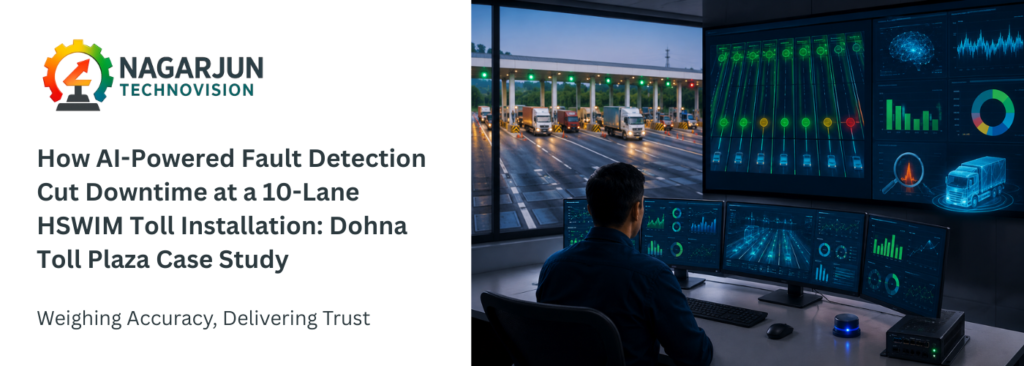
The monitoring dashboard provides engineers with real-time visibility across all 10 lanes.
Key features include:
- Live lane health status
- Sensor condition monitoring
- Controller diagnostics
- Network status
- Fault prediction scores
- Maintenance recommendations
- Historical trend analysis
- Alarm prioritization
- Calibration reminders
- Asset health reports
Instead of reacting to alarms, engineers work proactively.
Predictive Maintenance Workflow
The upgraded workflow became significantly more efficient.
Step 1
Continuous monitoring begins immediately after system startup.
Step 2
AI identifies abnormal operating patterns.
Step 3
Potential fault receives a risk score.
Step 4
Maintenance team receives an automated alert.
Step 5
Engineers inspect only the affected component.
Step 6
Repair is completed before system failure occurs.
Step 7
Lane returns to normal operation with minimal disruption.
Results Achieved at Dohna Toll Plaza
After implementing AI-powered diagnostics, measurable improvements were observed across the HSWIM installation.
Reduced Downtime
Unexpected equipment failures decreased significantly because most issues were detected before complete failure.
Faster Fault Identification
Engineers no longer spent hours locating faults.
AI pinpointed:
- Lane number
- Sensor location
- Device type
- Probable root cause
This reduced troubleshooting time dramatically.
Improved Maintenance Planning
Instead of emergency repairs, maintenance became scheduled.
Benefits included:
- Better spare inventory planning
- Reduced emergency site visits
- Lower overtime costs
- Increased equipment lifespan
Improved System Accuracy
Continuous health monitoring reduced calibration drift.
Benefits included:
- Better axle weight accuracy
- Reliable overload detection
- Improved legal compliance
- Increased confidence in enforcement data
Higher Lane Availability
More operational lanes meant:
- Better traffic flow
- Fewer service interruptions
- Improved toll operations
- Greater customer satisfaction
Key Performance Improvements
Although exact values vary by installation, AI-powered monitoring typically delivers:
| Performance Metric | Improvement |
|---|---|
| Fault Detection Time | Reduced from hours to minutes |
| Unplanned Downtime | Reduced significantly |
| Maintenance Response Time | Faster due to automated alerts |
| System Availability | Increased across all lanes |
| Preventive Maintenance Efficiency | Improved through predictive analytics |
| Asset Life | Extended with early intervention |
| Calibration Stability | Improved through continuous monitoring |
Technologies Behind AI Fault Detection
The solution combines multiple advanced technologies.
Machine Learning
Learns normal sensor behavior and identifies anomalies.
Edge Computing
Processes critical data locally for rapid decision-making.
IoT Connectivity
Collects real-time data from distributed field devices.
Predictive Analytics
Forecasts potential failures based on historical patterns.
Cloud Monitoring
Allows remote supervision of multiple toll plazas from a centralized dashboard.
Benefits for Toll Operators
Implementing AI-powered diagnostics provides several long-term advantages.
Operational Benefits
- Higher uptime
- Better lane availability
- Faster maintenance
- Reduced operational interruptions
Financial Benefits
- Lower maintenance costs
- Reduced equipment replacement
- Better asset utilization
- Increased operational efficiency
Compliance Benefits
- Improved axle weight accuracy
- Reliable enforcement records
- Better audit readiness
Future of AI in Weigh-in-Motion Systems
Artificial Intelligence is rapidly becoming a standard feature in intelligent transportation infrastructure.
Future HSWIM systems will include:
- Self-diagnosing sensors
- Automated calibration verification
- AI-assisted remote maintenance
- Digital twin simulations
- Predictive spare inventory management
- Automated software health monitoring
- Remote firmware optimization
These capabilities will further reduce maintenance costs while improving road safety and regulatory compliance.
Conclusion
The 10-lane HSWIM installation at Dohna Toll Plaza demonstrates how AI-powered fault detection can transform highway weighing operations. By shifting from reactive maintenance to predictive diagnostics, operators can reduce downtime, improve system accuracy, optimize maintenance schedules, and enhance overall operational efficiency.
As highway infrastructure becomes increasingly connected, integrating AI with High-Speed Weigh-in-Motion systems is no longer just an innovation—it is becoming a practical necessity for ensuring reliable, accurate, and uninterrupted toll and traffic management.
Frequently Asked Questions (FAQs)
1. What is AI-powered fault detection in an HSWIM system?
AI-powered fault detection uses machine learning and predictive analytics to continuously monitor HSWIM components such as load cells, bending plates, sensors, controllers, and communication networks. It identifies abnormal patterns and alerts maintenance teams before a component fails, helping prevent unexpected downtime.
2. How does AI reduce downtime at toll plazas?
Instead of waiting for equipment to fail, AI detects early warning signs such as sensor drift, communication issues, power fluctuations, or abnormal readings. This allows maintenance teams to perform preventive repairs, minimizing lane closures and keeping toll operations running smoothly.
3. Which HSWIM components can be monitored using AI?
An AI-based monitoring system can supervise a wide range of components, including:
- Bending Plate Sensors
- Load Cells
- HSWIM Indicators and Controllers
- Junction Boxes
- Ethernet Communication Networks
- Vehicle Detection Sensors
- Power Supply Units
- Environmental Sensors
- Industrial Switches and Network Devices
4. What are the key benefits of AI-powered predictive maintenance for HSWIM systems?
Some of the major benefits include:
- Reduced unplanned downtime
- Faster fault diagnosis
- Improved weighing accuracy
- Lower maintenance costs
- Extended equipment lifespan
- Better lane availability
- Increased operational efficiency and regulatory compliance
5. Can AI be integrated into an existing HSWIM installation?
Yes. In most cases, AI-based monitoring solutions can be integrated with existing HSWIM infrastructure without replacing the entire system. They work by collecting and analyzing data from existing sensors, controllers, and communication networks, making upgrades cost-effective.
6. Is AI-powered fault detection suitable for multi-lane toll plazas?
Absolutely. AI is especially valuable for multi-lane HSWIM installations because it continuously monitors each lane independently, identifies faults quickly, prioritizes maintenance activities, and provides centralized monitoring across all lanes, ensuring maximum system uptime.
7. How can Nagarjun Technovision help with AI-enabled HSWIM solutions?
Nagarjun Technovision provides end-to-end HSWIM solutions, including system design, installation, integration, preventive maintenance, troubleshooting, remote diagnostics, and AI-enabled monitoring solutions. Our expertise helps toll operators improve system reliability, reduce downtime, and maintain accurate vehicle weighing for efficient highway operations.