
Introduction
India’s rapidly expanding highway infrastructure has significantly increased freight movement across the country. While this growth supports economic development, overloaded commercial vehicles continue to pose a major challenge by causing premature pavement deterioration, bridge damage, safety hazards, and increased maintenance costs.
To address these issues, the Ministry of Road Transport and Highways (MoRTH) and the Indian Roads Congress (IRC) have established technical standards for Weigh-in-Motion (WIM) systems. Among these, IRC-SP-99 serves as one of the key specifications for Medium Speed Weigh-in-Motion (MSWIM) systems installed on expressways and toll plazas. Recent revisions of IRC-SP-99 include functional and performance requirements for MSWIM installations on expressways.
This guide explains everything you need to know about IRC-SP-99, MoRTH standards, certification requirements, compliance procedures, and best practices for installing WIM systems in India.
What is a Weigh-in-Motion (WIM) System?
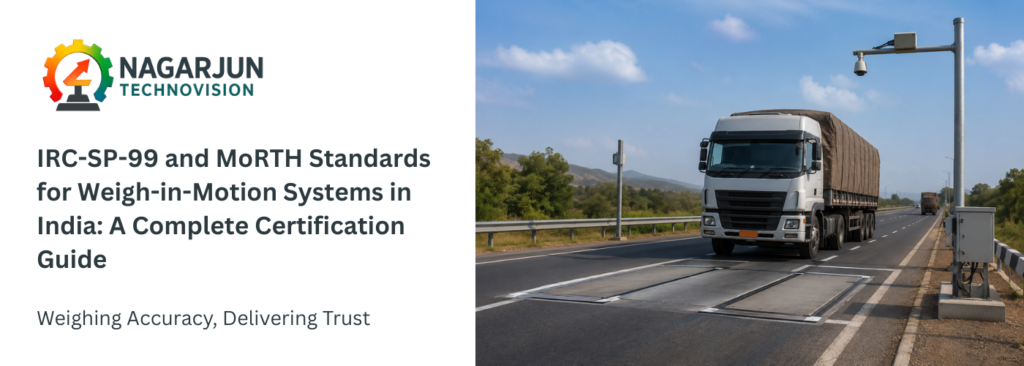
A Weigh-in-Motion (WIM) system measures the weight of moving vehicles without requiring them to stop. Unlike conventional weighbridges, WIM systems capture vehicle information in real time while traffic continues to flow.
Modern WIM systems can measure:
- Gross Vehicle Weight (GVW)
- Individual axle weight
- Axle spacing
- Vehicle speed
- Vehicle classification
- Number of axles
- Overloaded vehicle detection
- Traffic data for road asset management
WIM technology improves enforcement efficiency while reducing congestion at toll plazas and inspection stations.
Why are IRC-SP-99 and MoRTH Standards Important?
The standards ensure that every WIM installation delivers:
- Reliable weight measurements
- Uniform installation practices
- Accurate overload detection
- Highway safety
- Longer pavement life
- Standardized reporting
- Interoperability with toll management systems
These standards are particularly important for:
- National Highways
- Expressways
- Toll Plazas
- Freight Corridors
- Logistics Parks
- State Highways
Understanding IRC-SP-99
IRC-SP-99 is the Manual of Specifications and Standards for Expressways published by the Indian Roads Congress.
The latest revision includes dedicated specifications for Medium Speed Weigh-in-Motion (MSWIM) systems used at toll plazas and expressways, covering functional requirements and performance expectations.
Its objective is to provide uniform standards for:
- Highway infrastructure
- Intelligent Transportation Systems (ITS)
- Toll operations
- Safety systems
- Traffic monitoring
- Vehicle overload enforcement
MoRTH Standards for WIM Systems
The Ministry of Road Transport and Highways (MoRTH) specifies how WIM systems should be integrated into national highway infrastructure.
MoRTH guidelines focus on:
- Vehicle overload monitoring
- Pavement protection
- Data accuracy
- Highway safety
- Integration with toll systems
- Traffic enforcement
- System reliability
- Preventive maintenance
These specifications are widely adopted by NHAI concessionaires and highway operators.
Key Functional Requirements of IRC-SP-99 MSWIM
According to the current IRC-SP-99 specifications, an MSWIM system should be capable of:
- Detecting gross vehicle weight
- Measuring axle loads
- Counting axles
- Measuring axle spacing
- Detecting vehicle height
- Vehicle classification
- Providing overload warnings
- Communicating with lane controllers
- Operating within specified vehicle speed ranges
The standard also specifies performance parameters such as axle capacity and in-motion accuracy for medium-speed operation.
Components of a Compliant WIM System
A typical IRC-compliant Weigh-in-Motion installation includes:
1. Bending Plate Sensors
Installed beneath the pavement to measure axle loads.
2. Load Cells
Convert vehicle load into electrical signals.
3. Vehicle Separator Sensors
Detect vehicle entry and exit.
4. Loop Detectors
Identify vehicle presence.
5. WIM Controller
Processes all sensor inputs.
6. Junction Box
Connects all field sensors.
7. Industrial Computer
Stores and analyzes traffic data.
8. Camera System
Captures vehicle images and license plates.
9. LED Display
Displays overload warnings.
10. Central Management Software
Generates reports and communicates with the central server.
Typical Installation Locations
WIM systems are commonly installed at:
- Expressways
- Toll plazas
- Mining roads
- Industrial corridors
- Border check posts
- Ports
- Logistics hubs
- Freight terminals
Certification Requirements
Although project-specific requirements may vary, a compliant WIM installation generally requires:
Equipment Testing
All sensors must undergo factory testing.
Calibration
System calibration using certified reference vehicles.
Accuracy Verification
Measured weights must remain within specified tolerance limits.
Functional Testing
Verification of:
- Speed detection
- Axle counting
- Vehicle classification
- Data transmission
- Alarm generation
Site Acceptance Test (SAT)
Final verification before commissioning.
Calibration Process
Calibration generally includes:
- Sensor inspection
- Reference truck testing
- Static weighbridge comparison
- Software adjustment
- Repeatability verification
- Final validation report
Periodic recalibration helps maintain long-term accuracy.
Benefits of Compliance
Organizations that comply with IRC-SP-99 and MoRTH standards benefit from:
- Accurate overload detection
- Reduced pavement damage
- Lower maintenance costs
- Improved traffic flow
- Reliable enforcement
- Better asset management
- Increased toll efficiency
- Higher public safety
- Enhanced data quality
Common Challenges
During implementation, operators may encounter:
- Improper civil foundation
- Sensor misalignment
- Water ingress
- Temperature effects
- Heavy traffic vibration
- Cable damage
- Calibration drift
- Software integration issues
Regular preventive maintenance minimizes these risks.
Best Practices for Installation
For reliable long-term performance:
- Follow manufacturer installation guidelines.
- Use high-quality sensors and controllers.
- Ensure proper drainage around the installation.
- Install stable foundations.
- Perform periodic calibration.
- Maintain proper earthing.
- Protect underground cables.
- Monitor system health regularly.
- Keep software updated.
- Train maintenance personnel.
Applications Across India
Today, WIM systems are widely used for:
- National Highways
- Expressways
- FASTag-integrated toll plazas
- State Highway authorities
- Mining transport
- Cement industries
- Steel plants
- Smart city traffic monitoring
- Ports and logistics centers
Future of WIM Technology in India
India is rapidly adopting Intelligent Transportation Systems (ITS), making WIM technology increasingly important.
Future developments may include:
- AI-based overload prediction
- Automatic enforcement
- Cloud-based monitoring
- Digital twin infrastructure
- Remote diagnostics
- Integration with vehicle databases
- Predictive maintenance
- Smart highway analytics
Choosing the Right WIM Solution Provider
Before selecting a supplier, evaluate:
- Experience with highway projects
- Compliance with IRC and MoRTH specifications
- Manufacturing capability
- Calibration support
- After-sales service
- Availability of spare parts
- Software integration
- Annual Maintenance Contracts (AMC)
- Technical support across India
Conclusion
IRC-SP-99 and MoRTH standards provide the technical foundation for reliable, accurate, and standardized Weigh-in-Motion systems across India’s road network. By following these specifications, highway authorities and infrastructure operators can improve enforcement, reduce road damage, enhance safety, and optimize toll operations.
As India’s transportation infrastructure continues to expand, standards-compliant WIM systems will remain a critical component of intelligent highways, helping create safer, more efficient, and more sustainable road networks.
Frequently Asked Questions (FAQ)
What is IRC-SP-99?
IRC-SP-99 is the Indian Roads Congress Manual of Specifications and Standards for Expressways. The latest revision includes requirements for Medium Speed Weigh-in-Motion (MSWIM) systems.
What is the purpose of a Weigh-in-Motion system?
A WIM system measures the weight of moving vehicles without requiring them to stop, enabling efficient overload detection and traffic monitoring.
Is calibration mandatory for WIM systems?
Yes. Calibration and periodic verification are essential to maintain measurement accuracy and system reliability.
Where are WIM systems commonly installed?
They are typically installed on expressways, toll plazas, logistics hubs, mining roads, ports, and major freight corridors.
What are the main benefits of IRC-compliant WIM systems?
They improve overload enforcement, protect road infrastructure, enhance safety, reduce maintenance costs, and provide reliable traffic data.