
Introduction
Choosing the right industrial weighing system plays an important role in accurate measurement, efficient operations, inventory control, billing, and process automation. However, businesses often find it difficult to choose between a weighbridge, platform scale, and load cell system.
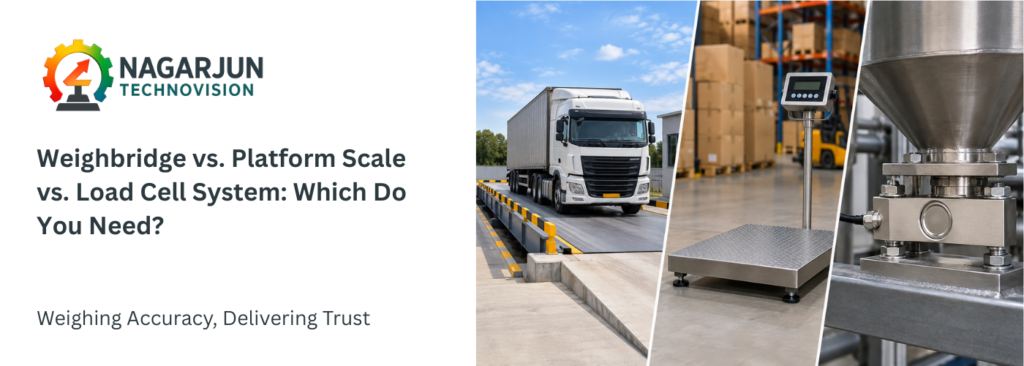
Although all three solutions measure weight, each one serves a different purpose. For example, a weighbridge primarily measures trucks and heavy vehicles, while a platform scale handles smaller loads such as bags, drums, pallets, and industrial materials. Meanwhile, a load cell system integrates directly with tanks, silos, hoppers, conveyors, platforms, and industrial machinery.
Therefore, understanding the differences between these weighing solutions can help you select the right system for your application.
What Is a Weighbridge?
A weighbridge, also known as a truck scale, is a heavy-duty weighing system that measures the weight of trucks and commercial vehicles.
Typically, a weighbridge consists of a large steel or concrete platform supported by multiple load cells. When a vehicle enters the platform, the load cells detect the applied force and convert it into an electrical signal. Then, the weighing indicator processes the signal and displays the vehicle weight.
Because of their high weighing capacity, industries commonly use weighbridges at manufacturing plants, logistics facilities, mining sites, cement plants, steel plants, warehouses, recycling facilities, construction sites, ports, agricultural facilities, and infrastructure projects.
How Does a Weighbridge Work?
Generally, vehicle weighing involves measuring both gross weight and tare weight.
Gross Weight: The total weight of the loaded vehicle.
Tare Weight: The weight of the empty vehicle.
Net Weight = Gross Weight − Tare Weight
For example, if a loaded truck weighs 48,000 kg and the empty truck weighs 18,000 kg:
Net Weight = 48,000 − 18,000 = 30,000 kg
Therefore, the truck carries approximately 30,000 kg of material.
Furthermore, modern weighbridge systems can work with weighing software, RFID readers, ANPR cameras, traffic lights, boom barriers, printers, CCTV cameras, and other automation equipment.
Types of Weighbridges
Different sites have different operational and installation requirements. Therefore, manufacturers offer several weighbridge configurations.
Pit Type Weighbridge
A pit-type weighbridge sits approximately at road level, while the supporting structure and load cells remain inside a prepared pit.
As a result, vehicles can approach the weighing platform without long elevated ramps. Therefore, this design can work well at sites with limited space.
Pitless Weighbridge
A pitless weighbridge sits above ground level and generally uses approach and exit ramps.
In comparison, this configuration can provide easier access to the structure and load cells for inspection, cleaning, and maintenance. However, the ramps require additional installation space.
Portable Weighbridge
A portable or mobile weighbridge offers greater flexibility when a project may require relocation.
For example, construction, mining, infrastructure, and temporary industrial projects may benefit from a portable weighing solution. Moreover, a modular design can simplify transportation and installation.
Modular Weighbridge
A modular weighbridge uses multiple platform sections that technicians assemble at the installation site.
Consequently, modular construction can simplify transportation, installation, maintenance, and replacement of individual structural sections. Additionally, it can offer flexibility for different site requirements.
What Is a Platform Scale?
A platform scale is a compact weighing machine that uses a flat platform to weigh materials placed directly on its surface.
Compared with a weighbridge, platform scales are generally designed for considerably smaller loads.
They are commonly used for:
- Bags
- Boxes
- Drums
- Raw materials
- Finished goods
- Parcels
- Components
- Pallets
- Agricultural products
- Warehouse materials
Platform scales are widely used in warehouses, factories, retail operations, logistics centers, workshops, and production facilities.
How Does a Platform Scale Work?
The material is placed on the platform, and one or more load cells underneath the structure detect the applied load.
The signal travels to a weighing indicator, which converts it into a readable weight value.
Depending on the application, platform scales can be integrated with printers, computers, production software, ERP systems, or other industrial automation systems.
What Is a Load Cell System?
A load cell system is different from a complete weighbridge or platform scale.
A load cell is the sensing component that converts mechanical force or weight into an electrical signal.
In fact, load cells are commonly used inside both weighbridges and platform scales.
However, they can also be installed directly into industrial equipment to create customized weighing solutions.
Typical load cell applications include:
- Tanks
- Silos
- Hoppers
- Batching systems
- Mixing systems
- Conveyor systems
- Industrial platforms
- Storage vessels
- Material handling equipment
- Process machinery
- Custom weighing machines
A typical load cell weighing system may include:
Load Cells → Junction Box → Weighing Indicator/Controller → PLC/Computer/Software
This configuration makes load cell systems particularly useful for industrial automation and process monitoring.
Weighbridge vs. Platform Scale vs. Load Cell System
Understanding the main differences makes selecting the right system easier.
| Feature | Weighbridge | Platform Scale | Load Cell System |
|---|---|---|---|
| Primary purpose | Vehicle weighing | Material/product weighing | Integrated/custom weighing |
| Typical load | Heavy vehicles | Small to medium loads | Depends on system design |
| Installation | Permanent or portable | Floor/industrial area | Integrated into equipment |
| Main weighing surface | Large vehicle platform | Small/medium platform | Existing structure or custom system |
| Load cells | Multiple heavy-duty load cells | One or more load cells | Selected according to application |
| Automation | High | Moderate | Very high |
| Vehicle weighing | Yes | Generally no | Possible with suitable system design |
| Tank/silo weighing | No | No | Yes |
| Batching application | Limited | Limited | Excellent |
| Portability | Depends on design | Usually easy | Depends on application |
| Customization | High | Moderate | Very high |
| Common industries | Logistics, mining, highways, manufacturing | Warehouse, factory, retail | Manufacturing, process industries, automation |
When Should You Choose a Weighbridge?
A weighbridge is generally the appropriate solution when your main requirement is weighing complete vehicles.
For example, consider a manufacturing facility where trucks regularly enter with raw materials and leave carrying finished products.
The business needs to know:
- Vehicle gross weight
- Vehicle tare weight
- Net material weight
- Vehicle number
- Material details
- Customer or supplier information
- Date and time
- Transaction history
A weighbridge combined with weighing software can record and manage these transactions efficiently.
Choose a weighbridge when:
- You need to weigh trucks or commercial vehicles.
- Your loads are extremely heavy.
- Material quantity is calculated from vehicle weight.
- Vehicle transaction records are required.
- You need integration with RFID, ANPR, barriers, cameras, or software.
- Your facility handles regular incoming and outgoing truck traffic.
When Should You Choose a Platform Scale?
Choose a platform scale when individual materials or products need to be weighed rather than an entire vehicle.
For example, a warehouse may need to weigh 50 kg bags, 200 kg drums, or loaded pallets.
Installing a truck weighbridge for these applications would usually be unnecessary.
A platform scale provides a simpler and more compact solution.
Choose a platform scale when:
- You weigh bags, cartons, drums, or pallets.
- The weighing capacity is relatively moderate.
- Space is limited.
- Operators need quick manual weighing.
- The weighing system may need to be moved.
- Vehicle weighing is not required.
When Should You Choose a Load Cell System?
A load cell system is generally suitable when weight measurement must become part of an existing machine, structure, or automated industrial process.
Consider a cement, chemical, food-processing, or manufacturing plant.
Instead of manually moving material onto a separate scale, load cells can be installed underneath a hopper or tank.
The system can continuously measure the material weight and send the information to a controller, PLC, or software system.
Choose a load cell system when:
- You need tank or silo weighing.
- You are developing a batching system.
- Weight measurement must be integrated into machinery.
- Automatic filling or dosing is required.
- You need PLC integration.
- Continuous weight monitoring is required.
- A standard weighing platform cannot accommodate the application.
Example 1: Logistics Company
Suppose a logistics facility handles trucks carrying 20–50 tonnes of material.
The company needs to calculate exactly how much material each truck transports.
Recommended solution: Weighbridge
The truck can be weighed when loaded and again when empty. The difference provides the net material weight.
Example 2: Warehouse
A warehouse regularly handles cartons, bags, drums, and pallets ranging from a few kilograms to several hundred kilograms.
Recommended solution: Platform Scale
A platform scale provides straightforward weighing without requiring large civil infrastructure.
Example 3: Manufacturing Plant
A production facility has a hopper containing raw material. Operators need to know how much material enters and leaves the hopper.
Recommended solution: Load Cell System
Load cells can be installed underneath the hopper so the weight becomes available directly to the control system.
Example 4: Automated Batching Plant
Suppose several ingredients must be added according to predefined quantities.
Recommended solution: Load Cell-Based Weighing System
The controller can monitor weight continuously and control valves, feeders, or conveyors according to the required batching sequence.
How to Choose the Right Weighing System
Before purchasing any industrial weighing equipment, evaluate the actual application rather than selecting equipment based only on maximum capacity.
Consider the following factors:
1. What Are You Weighing?
This should be your first question.
Truck or vehicle → Weighbridge
Bag, box, drum, pallet → Platform Scale
Tank, hopper, silo, machine → Load Cell System
2. What Is Your Maximum Required Capacity?
Determine both the normal operating load and the maximum possible load.
Selecting the correct capacity is important for measurement performance, equipment life, and safety.
3. What Accuracy Do You Need?
Required accuracy varies significantly between applications.
A manufacturing batching process may have different accuracy requirements from vehicle weighing or warehouse material measurement.
Your weighing-system supplier should evaluate factors such as capacity, division size, load distribution, mechanical structure, installation environment, and application requirements.
4. What Is the Installation Environment?
Industrial weighing equipment can be exposed to:
- Dust
- Rain
- Water
- Mud
- Vibration
- Temperature variations
- Heavy traffic
- Electrical interference
- Corrosive environments
Load cells, junction boxes, cables, indicators, and structural components should therefore be selected according to actual site conditions.
5. Do You Need Automation?
Modern weighing systems can provide much more than a number on an indicator.
Depending on the application, the system can integrate with:
- RFID readers
- ANPR cameras
- Boom barriers
- Traffic lights
- CCTV
- Printers
- PLCs
- Computers
- ERP systems
- Cloud platforms
- Weighing software
If automation is part of your future plan, discuss integration requirements before selecting the weighing hardware.
6. What Are Your Maintenance Requirements?
Consider accessibility for:
- Load cell inspection
- Cable inspection
- Junction box maintenance
- Structural inspection
- Cleaning
- Calibration
- Indicator servicing
A system that is easier to inspect and maintain can reduce operational downtime.
Can the Same Load Cell Be Used for Every Application?
No.
Different weighing applications require different types and capacities of load cells.
Common load cell designs include:
- Compression load cells
- Shear beam load cells
- Double-ended shear beam load cells
- S-type load cells
- Single-point load cells
- Canister load cells
The correct selection depends on capacity, mounting arrangement, loading direction, environmental conditions, required accuracy, mechanical design, and application.
Therefore, load cell selection should be based on the complete weighing-system design rather than capacity alone.
Weighbridge or Weigh-in-Motion System?
Another important distinction is between a conventional weighbridge and a Weigh-in-Motion (WIM) system.
A conventional static weighbridge generally requires the vehicle to stop for weighing.
A WIM system measures vehicle axle loads and other relevant vehicle data while the vehicle moves across sensors installed in or on the roadway.
Depending on system design and application, WIM technology can support:
- Axle weight measurement
- Gross vehicle weight estimation or measurement
- Vehicle classification
- Overload monitoring
- Traffic data collection
- Toll-management integration
- Vehicle identification integration
- Automated monitoring
WIM solutions can therefore be useful for highways, toll plazas, logistics facilities, industrial sites, and other applications where continuous vehicle movement is important.
Static Weighing vs. Dynamic Weighing
Static weighing measures a stationary load. Conventional weighbridges and most platform scales operate on this principle.
Dynamic weighing measures loads while they are moving.
This distinction becomes particularly important in vehicle applications.
A facility processing a relatively small number of trucks may use a conventional weighbridge, while high-volume traffic environments may consider dynamic vehicle weighing or WIM solutions depending on operational and regulatory requirements.
Can a Weighbridge Be Automated?
Yes.
A conventional weighbridge can be transformed into a highly automated weighing station.
An automated weighbridge may integrate:
Vehicle Detection → RFID/ANPR Identification → Vehicle Positioning → Weight Capture → Software Validation → Photo/CCTV Record → Ticket Generation → Barrier Control
This can reduce manual data entry and create a more traceable vehicle-weighing process.
Common Mistakes When Selecting Industrial Weighing Equipment
One common mistake is selecting a weighing system only by comparing prices.
The lowest initial equipment price does not necessarily mean the lowest total operating cost.
Other important considerations include:
- Structural quality
- Load cell quality
- Indicator performance
- Calibration requirements
- Installation quality
- Environmental protection
- Spare-part availability
- Software compatibility
- Service support
- Future expansion
- Automation capability
A properly designed weighing solution should be selected according to the complete application.
Which Weighing Solution Do You Need?
The simplest way to decide is to identify what you actually need to weigh.
Need to weigh complete trucks?
Choose a weighbridge.
Need to weigh bags, cartons, drums, pallets, or individual products?
Choose a platform scale.
Need to measure weight inside a tank, silo, hopper, conveyor, or industrial machine?
Choose a load cell system.
Need to weigh vehicles while they are moving?
Consider a Weigh-in-Motion (WIM) system.
The final system should always be selected according to required capacity, accuracy, installation conditions, operating environment, automation requirements, and applicable legal-metrology or industry requirements.
Conclusion
Choosing the right industrial weighing system depends on what you need to weigh, the required capacity, accuracy, operating environment, and automation needs.
A weighbridge works well when you need to weigh trucks and other heavy vehicles. In contrast, a platform scale offers a practical solution for weighing bags, cartons, drums, pallets, and other smaller industrial loads. Meanwhile, a load cell system provides greater flexibility for tanks, silos, hoppers, batching equipment, and automated production systems.
Moreover, if you need to measure vehicle weight while traffic remains in motion, you can consider a Weigh-in-Motion (WIM) system.
However, you should not choose a weighing system based only on price or maximum capacity. Instead, consider accuracy, installation conditions, maintenance, calibration, software integration, automation, and future expansion. As a result, you can select a system that supports both your current operations and future requirements.
Nagarjun Technovision Pvt. Ltd. provides industrial weighing solutions, including weighbridges, Weigh-in-Motion systems, load cells, weighing indicators, bending plate sensors, software integration, and customized weighing solutions.
Weighing Accuracy, Delivering Trust.
Frequently Asked Questions (FAQs)
1. What is the main difference between a weighbridge and a platform scale?
A weighbridge measures the weight of trucks and other heavy vehicles. In contrast, a platform scale measures smaller loads such as bags, cartons, drums, pallets, and industrial materials. Therefore, weighbridges usually offer much larger platforms and higher weighing capacities than platform scales.
2. Is a load cell the same as a weighing scale?
No. A load cell acts as the sensing component of a weighing system and converts force into an electrical signal. For example, manufacturers use load cells in weighbridges, platform scales, tanks, silos, hoppers, and batching systems. A complete weighing scale combines load cells with a mechanical structure, weighing indicator, electronics, and other required components.
3. Which weighing system should I use for trucks?
A weighbridge provides a practical solution when you need to weigh complete trucks while they remain stationary. However, if you need to measure vehicle weight while vehicles continue moving, you can consider a Weigh-in-Motion (WIM) system. Your final choice should depend on vehicle speed, required accuracy, traffic volume, application, and regulatory requirements.
4. Can I use load cells for tank and silo weighing?
Yes. You can install load cells beneath tanks, silos, hoppers, and similar structures to measure the weight of stored materials. Furthermore, you can connect the load cells to weighing indicators, PLCs, controllers, or software. As a result, the system can support real-time monitoring, batching, filling, and process automation.
5. Can I automate a weighbridge with ANPR, RFID, and software?
Yes. You can integrate a modern weighbridge with ANPR cameras, RFID readers, boom barriers, traffic lights, CCTV, printers, and weighing software. Moreover, automation can reduce manual data entry, improve transaction traceability, and streamline vehicle movement through the weighing process.
6. How do I choose the right industrial weighing system?
First, identify what you need to weigh and determine the maximum expected load. Next, consider the required accuracy, installation space, environmental conditions, weighing frequency, and maintenance requirements. Additionally, evaluate whether you need software, PLC, RFID, ANPR, or other automation features. Finally, choose a weighing system that meets your present requirements while allowing for future expansion.