
Introduction
Vehicle weighing technology has changed dramatically over the past four decades.
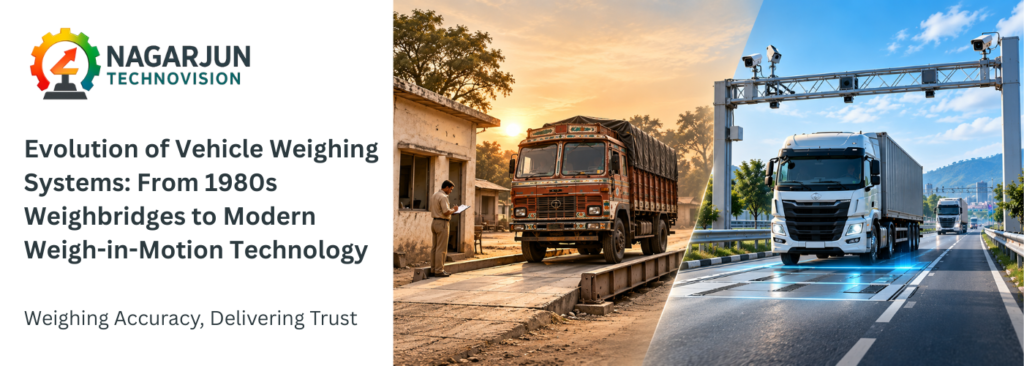
In the 1980s, commercial vehicle weighing mainly relied on static weighbridges. Trucks usually had to stop on a weighing platform, while operators manually recorded weight and vehicle information.
Today, the industry uses far more connected and automated technology. Weigh-in-Motion (WIM) systems can measure vehicles while they are moving. In addition, electronic sensors, digital indicators, ANPR cameras, vehicle classification systems and traffic management platforms can work together within one integrated solution.
Although the basic objective remains the same—measuring vehicle weight accurately and reliably—technology has completely changed how organizations collect, process, store and use that information.
Therefore, the evolution of vehicle weighing systems represents much more than a change in weighing equipment. It reflects the wider transformation of transportation infrastructure from manual measurement to intelligent, data-driven operations.
Vehicle Weighing Systems in the 1980s
During the 1980s, static weighbridges handled most commercial vehicle weighing applications.
A truck would drive onto the platform and stop while the weighing system measured its weight. Depending on the installation, operators used mechanical, electromechanical or early electronic equipment.
Furthermore, operators handled much of the process manually. They recorded vehicle details, weight readings and transaction information on paper.
These systems served an important purpose at the time. However, compared with today’s technology, they required more manual intervention and offered limited connectivity.
Additionally, processing each truck took time because the vehicle generally had to stop before operators could complete the weighment.
As a result, traditional weighing primarily focused on answering one basic question:
How much does this vehicle weigh?
The Shift from Mechanical to Electronic Weighing
The introduction of electronic load cells, digital indicators and computerized weighing systems marked an important turning point.
Electronic load cells converted mechanical force into electrical signals. Digital indicators then processed these signals and displayed the measured weight.
Moreover, computers allowed businesses to manage weighing information more efficiently.
Digital systems introduced features such as:
- Automatic weighment records
- Ticket generation
- Vehicle databases
- Customer and material records
- Transaction history
- Report generation
- Centralized data storage
Consequently, weighbridges became more than standalone measuring devices.
However, conventional static weighing still required vehicles to stop. This limitation encouraged the development of dynamic weighing technologies such as Weigh-in-Motion.
What Is a Weigh-in-Motion System?
A Weigh-in-Motion (WIM) system measures or estimates axle loads and vehicle weight while a vehicle travels across sensors installed in or near the roadway.
Unlike a conventional static weighbridge, WIM technology allows traffic to continue moving during the initial weighing process.
Depending on the application, a WIM system can capture information such as:
Axle load | Gross vehicle weight | Number of axles | Vehicle speed | Vehicle class | Date and time | Lane information
Furthermore, operators can combine WIM with cameras, ANPR and traffic-management technology.
As a result, weighing becomes part of a much larger intelligent transportation ecosystem.
1980s Vehicle Weighing vs Modern Vehicle Weighing
| 1980s Weighing | Modern Weighing |
|---|---|
| Predominantly static weighing | Static and dynamic weighing |
| Vehicle generally stops for measurement | WIM can measure moving vehicles |
| Mechanical/electromechanical systems common | Electronic sensors and digital systems |
| Greater dependence on manual operation | Higher levels of automation |
| Manual and paper-based records common | Digital records and centralized databases |
| Limited system connectivity | Integration with ANPR, cameras and TMS |
| Weight as the primary output | Weight, axle data and vehicle information |
| Mostly standalone equipment | Connected infrastructure |
| Limited real-time analytics | Real-time monitoring and analytics possible |
The difference therefore goes far beyond replacing mechanical equipment with electronic sensors.
Modern vehicle weighing is increasingly about connectivity, automation and data.
Static Weighbridge vs Weigh-in-Motion
Static weighbridges continue to play an essential role in vehicle weighing.
Factories, logistics centers, mines, construction sites, ports and warehouses commonly use them when vehicles can stop for accurate stationary weighing.
WIM, however, serves a different purpose.
Highways may carry thousands of commercial vehicles each day. Stopping every vehicle for initial weighing could significantly affect traffic flow.
Therefore, WIM technology can screen moving vehicles and identify those that may require further inspection.
For example, operators can use WIM for initial overload screening and then direct selected vehicles toward a static weighing facility where necessary.
Thus, static weighbridges and WIM systems complement each other rather than simply competing with one another.
Different Types of Modern WIM Systems
Modern WIM solutions can be designed for different operating environments, speeds and accuracy requirements.
1. SSWIM – Slow-Speed Weigh-in-Motion
Slow-Speed Weigh-in-Motion (SSWIM) systems are designed for applications where vehicles travel over the weighing system at controlled, relatively low speeds.
They can be useful in locations such as toll plazas, controlled lanes and industrial entry or exit points.
The controlled vehicle movement can help create a structured weighing environment while reducing the need for a conventional stop-and-weigh process.
2. MSWIM – Medium-Speed Weigh-in-Motion
Medium-Speed Weigh-in-Motion (MSWIM) provides dynamic vehicle weighing at higher operating speeds than typical slow-speed applications.
Depending on system design, sensors such as bending plates and associated electronics can capture axle-related information as vehicles cross the weighing zone.
MSWIM can be useful for highway, tolling and traffic-monitoring applications where vehicle throughput is important.
3. HS-WIM – High-Speed Weigh-in-Motion
High-Speed Weigh-in-Motion (HS-WIM) takes dynamic weighing further by allowing weight-related data to be collected from vehicles travelling at highway speeds, subject to the capabilities and specifications of the particular system.
This can support applications such as traffic monitoring, overloaded-vehicle screening, infrastructure planning and intelligent transportation systems.
From Weight Measurement to Vehicle Intelligence
Perhaps the biggest transformation involves data rather than hardware.
Traditional systems mainly answered:
“How much does this vehicle weigh?”
In contrast, an integrated modern system can provide much more information:
- Which vehicle crossed the weighing point?
- How many axles does it have?
- What load does each axle carry?
- What is the gross vehicle weight?
- What type of vehicle is it?
- When did it cross?
- Which lane did it use?
- Is it potentially overloaded?
- Does the vehicle require further inspection?
Therefore, modern weighing has evolved from simple weight measurement toward vehicle intelligence and automated decision support.
Integration of WIM with ANPR and Traffic Management Systems
Another major advancement is system integration.
ANPR Cameras
Automatic Number Plate Recognition (ANPR) technology can identify a vehicle’s registration number and associate it with the corresponding weighing event.
Vehicle Classification
Vehicle classification technology can identify different vehicle categories using axle configuration, dimensions and other parameters.
CCTV and Imaging Systems
Cameras provide visual evidence and additional information for each vehicle crossing.
Traffic Management Systems
A Traffic Management System (TMS) can receive information from WIM equipment, ANPR cameras and other roadside devices.
Centralized Software
Finally, centralized software can store weighing transactions, create reports and provide operators with valuable operational information.
When organizations integrate these technologies, a weighing location becomes part of a connected intelligent transportation system.
Role of WIM in Overloaded Vehicle Detection
Vehicle overloading remains an important concern for highway infrastructure.
Excessive axle loads can accelerate pavement deterioration. Moreover, overloaded vehicles may create additional operational and road-safety challenges.
Traditionally, authorities may need to stop vehicles before determining whether they exceed permitted weight limits.
WIM technology can improve this process through vehicle pre-screening.
For example, the system can identify potentially overloaded vehicles while traffic continues to move. Authorities can then direct selected vehicles toward further inspection or statutory weighing, depending on the applicable regulations.
Consequently, WIM can make overload screening more efficient without unnecessarily stopping every commercial vehicle.
Why Axle Weight Matters
Gross vehicle weight tells only part of the story.
Roads receive vehicle loads through individual tyres and axles. Therefore, axle-load distribution also plays an important role in pavement performance and vehicle-load analysis.
Modern WIM systems can capture valuable axle-related information alongside gross vehicle weight.
This data can support:
- Overload screening
- Traffic studies
- Pavement analysis
- Vehicle classification
- Infrastructure planning
- Commercial traffic analysis
As a result, highway operators gain deeper insights than they would receive from gross weight alone.
Real-Time Data Is Changing Vehicle Weighing
Another major change involves the speed at which operators can access information.
Traditional processes often required staff to review records after weighing took place. In contrast, connected systems can provide information almost immediately.
Depending on the system configuration, operators can monitor:
Vehicle weight, axle information, classification, crossing time, lane, speed and vehicle identification data.
Therefore, modern systems support faster decision-making and improved operational visibility.
Moreover, organizations can analyze historical data to better understand traffic patterns, vehicle loading and infrastructure usage.
Benefits of Modern Vehicle Weighing Technology
Modern vehicle weighing technology offers several potential advantages.
First, automation can reduce manual data entry. Second, digital records improve traceability and reporting. Furthermore, integration allows multiple highway or industrial systems to exchange useful information.
WIM systems can also support higher traffic throughput because vehicles do not necessarily need to stop during initial screening.
Meanwhile, modern static weighbridges can use computerized software to simplify transactions, reporting and vehicle management.
However, actual system performance depends on several factors, including installation quality, calibration, road conditions, maintenance, operating environment and system specifications.
Is the Traditional Weighbridge Becoming Obsolete?
No. Static weighbridges remain highly relevant.
Industrial facilities, logistics centers, mines, ports and infrastructure projects continue to rely on stationary weighing.
However, WIM solves a different problem.
When traffic flow and high-volume vehicle screening matter, dynamic weighing offers significant operational advantages.
Therefore, the future is unlikely to become a simple choice between weighbridge or WIM.
Instead, organizations will increasingly use integrated weighing ecosystems that combine static weighing, WIM, cameras, ANPR and intelligent software.
The Future: AI-Powered Intelligent Weighing Systems
The next stage of vehicle weighing will focus increasingly on connectivity, analytics and intelligent automation.
For example, advanced systems can combine data from weighing sensors, ANPR cameras, vehicle classification systems and traffic-monitoring devices.
Furthermore, AI and advanced analytics could support applications such as:
- Automated vehicle classification
- Anomaly detection
- Traffic-pattern analysis
- Predictive maintenance
- Overload screening
- Centralized infrastructure monitoring
Cloud connectivity can also allow operators to monitor multiple weighing locations through a centralized platform.
Consequently, the weighing system of the future will do much more than display kilograms.
It will serve as an important data source for intelligent transportation and industrial infrastructure.
Nagarjun Technovision and the Future of Vehicle Weighing
At Nagarjun Technovision Pvt. Ltd., we focus on modern vehicle weighing solutions for highway, infrastructure and industrial applications.
Our capabilities cover areas such as:
Static Weighbridges | SSWIM | MSWIM | Weigh-in-Motion Systems | Axle Weighing | Sensors | Weighing Electronics | System Integration
As India’s highway and industrial infrastructure becomes increasingly digital, weighing technology must evolve as well.
Therefore, our vision goes beyond measuring vehicle weight.
We aim to support an ecosystem that can weigh, identify, connect, analyze and use vehicle data intelligently.
From traditional static weighbridges to modern Weigh-in-Motion systems, vehicle weighing has already experienced a remarkable transformation.
The next generation of intelligent weighing has only just begun.
Frequently Asked Questions (FAQ)
1. What is the difference between a traditional weighbridge and a WIM system?
A traditional weighbridge normally weighs a stationary vehicle on a weighing platform. A Weigh-in-Motion system estimates axle loads and vehicle weight while the vehicle travels over the weighing sensors.
2. What does WIM stand for?
WIM stands for Weigh-in-Motion. It refers to technology used to collect weight-related information from vehicles while they are moving.
3. Can a WIM system detect overloaded vehicles?
WIM systems can be used to screen vehicles for potential overloading. The exact enforcement process depends on system specifications, applicable standards and regulatory requirements.
4. What are SSWIM, MSWIM and HS-WIM?
SSWIM refers to Slow-Speed Weigh-in-Motion, MSWIM to Medium-Speed Weigh-in-Motion, and HS-WIM to High-Speed Weigh-in-Motion. They represent WIM applications designed for different vehicle operating speeds and use cases.
5. Can WIM integrate with ANPR?
Yes. WIM can be integrated with ANPR and other systems so that vehicle identification information can be associated with a weighing event.
6. Are static weighbridges still relevant?
Yes. Static weighbridges remain important for industrial, logistics, mining, infrastructure and commercial weighing applications where stationary weighing is required.
7. What is the future of vehicle weighing systems?
The industry is moving toward more connected systems combining WIM, digital sensors, ANPR, vehicle classification, centralized software, cloud connectivity, analytics and intelligent automation.