
Introduction
Weigh-in-Motion (WIM) technology has completely transformed vehicle weight monitoring. Instead of stopping vehicles, businesses and authorities can now measure weight while vehicles are in motion.
However, choosing the right system is critical. In particular, the decision between high-speed and low-speed WIM depends on your use case.
So, in this guide, we will clearly explain high speed vs low speed WIM, their differences, benefits, and ideal applications.
What is a Weigh-in-Motion (WIM) System?
A Weigh-in-Motion system measures the weight of moving vehicles without interrupting traffic flow.
Unlike traditional weighbridges, WIM systems improve efficiency and reduce waiting time. As a result, industries experience faster operations and better data accuracy.
Key Components:
- Sensors (load cells, piezoelectric, bending plates)
- Data acquisition system
- Software for analysis and reporting
- Camera integration (optional)
What is High-Speed WIM?
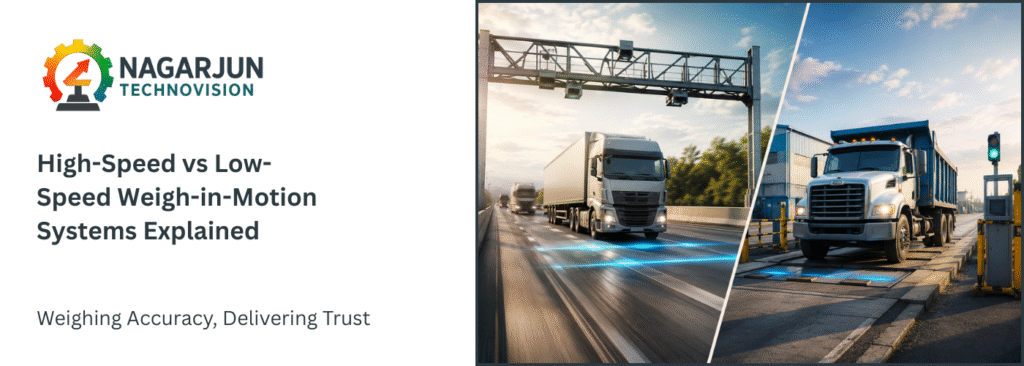
High-speed WIM systems operate on highways where vehicles move at normal speeds. Typically, these systems work within a range of 40–120 km/h.
Because vehicles do not need to slow down, traffic continues smoothly. Therefore, these systems are ideal for large-scale monitoring.
Key Features:
- Real-time vehicle weighing
- No traffic disruption
- Advanced sensor technology
- Integration with enforcement systems
Benefits:
- Firstly, they maintain continuous traffic flow
- Secondly, they handle high vehicle volumes efficiently
- Moreover, they support law enforcement and compliance
- Additionally, they improve road safety
Limitations:
- Slightly lower accuracy compared to low-speed systems
- Higher installation complexity
- Requires regular calibration
What is Low-Speed WIM?
Low-speed WIM systems operate where vehicles move slowly, usually 5–15 km/h. These are commonly installed at industrial entry/exit points.
Key Features:
- High accuracy measurement
- Controlled vehicle movement
- Often replaces static weighbridges
- Suitable for internal operations
Benefits:
- High precision
- Cost-effective
- Easy installation
- Minimal maintenance
Limitations:
- Requires vehicles to slow down
- suitable for highways
- Lower throughput compared to high-speed systems
High-Speed vs Low-Speed WIM: Key Differences
| Feature | High-Speed WIM | Low-Speed WIM |
|---|---|---|
| Speed Range | 40–120 km/h | 5–15 km/h |
| Accuracy | Moderate | High |
| Installation Location | Highways, toll roads | Industrial sites, warehouses |
| Traffic Flow | Continuous | Controlled |
| Cost | Higher | Lower |
| Use Case | Enforcement, monitoring | Billing, internal logistics |
Applications of High-Speed WIM
High-speed WIM systems are widely used in:
- Highway weight enforcement
- Toll plazas
- Smart city traffic systems
- Overload detection
- Road safety monitoring
They are crucial for government authorities to prevent overloading and road damage.
Applications of Low-Speed WIM
Low-speed WIM systems are ideal for:
- Manufacturing plants
- Mining operations
- Logistics hubs
- Ports and warehouses
- Industrial gate entry systems
They help businesses with accurate billing, inventory tracking, and operational efficiency.
Which WIM System Should You Choose?
Choosing between high speed vs low speed WIM depends on your specific needs.
Choose High-Speed WIM if:
- You need highway monitoring
- Traffic flow must not be interrupted
- You require enforcement capabilities
- High vehicle volume is expected
Choose Low-Speed WIM if:
- Accuracy is critical
- You operate in a controlled environment
- Vehicles can slow down
- You want a cost-effective solution
Future of WIM Technology
The future of WIM systems is driven by:
- AI-powered traffic analytics
- Integration with smart cities
- Automated enforcement systems
- Cloud-based monitoring platforms
Both high-speed and low-speed WIM systems will continue to evolve, offering greater accuracy, efficiency, and automation.
Conclusion
Understanding the difference between high speed vs low speed WIM is essential for making the right investment.
- High-speed WIM is best for highways and enforcement
- Low-speed WIM is ideal for industrial and commercial use
By selecting the right system, you can improve efficiency, compliance, and profitability.
FAQs
1. What is the main difference between high-speed and low-speed WIM?
High-speed WIM works at normal road speeds, while low-speed WIM requires vehicles to slow down for more accurate measurement.
2. Which WIM system is more accurate?
Low-speed WIM systems are generally more accurate due to controlled conditions.
3. Can high-speed WIM be used for billing?
It is mainly used for monitoring and enforcement, not precise billing.
4. Is low-speed WIM a replacement for weighbridges?
Yes, in many industrial applications, it can replace traditional weighbridges.
5. What industries use WIM systems?
Transportation, logistics, mining, manufacturing, and government sectors commonly use WIM systems.