
Introduction
When it comes to accurate vehicle weighing, businesses often face a crucial choice: weighbridge vs weigh in motion systems. Both technologies serve the same core purpose—measuring vehicle weight—but they differ significantly in operation, speed, accuracy, and use cases.
So, which one is better for your business? The answer depends on your operational needs, budget, and industry requirements. In this guide, we’ll break down everything you need to know to make the right decision
What is a Weighbridge?
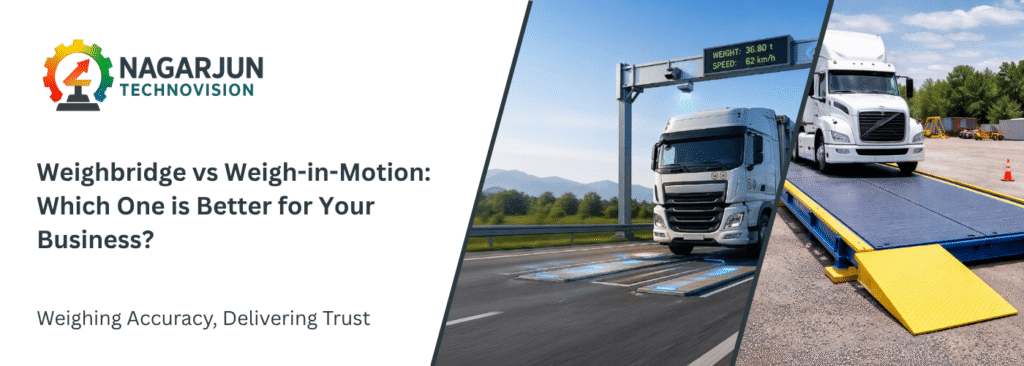
A weighbridge (also known as a truck scale) is a static weighing system where vehicles must come to a complete stop to measure their weight.
Key Features:
- High accuracy (legal-for-trade certified)
- Ideal for billing and compliance
- Available in pit-mounted or pitless types
- Suitable for heavy-duty industrial use
Best Used For:
- Government checkpoints
- Mining and construction industries
- Logistics and freight billing
- Manufacturing plants
What is Weigh-in-Motion (WIM)?
A Weigh-in-Motion system measures vehicle weight while the vehicle is moving, eliminating the need to stop.
Key Features:
- High-speed vehicle weighing
- Real-time data collection
- Traffic flow monitoring
- Lower accuracy compared to static systems
Best Used For
- Highways and toll plazas
- Traffic enforcement
- Overload detection
- Smart city infrastructure
Weighbridge vs Weigh-in-Motion: Key Differences
| Feature | Weighbridge | Weigh-in-Motion |
|---|---|---|
| Operation | Static (vehicle stops) | Dynamic (vehicle moves) |
| Accuracy | Very high | Moderate to high |
| Speed | Slow | Fast |
| Use Case | Billing & compliance | Monitoring & screening |
| Cost | Moderate | Higher initial cost |
| Throughput | Low | High |
Advantages of Weighbridge
✔ High Accuracy
Weighbridges provide extremely precise measurements, making them ideal for commercial transactions and legal compliance.
✔ Reliable for Billing
If your business depends on weight-based billing, a weighbridge is essential.
✔ Durable and Long-Lasting
Designed for heavy loads and continuous usage.
Advantages of Weigh-in-Motion
✔ No Need to Stop Vehicles
Improves efficiency and reduces traffic congestion.
✔ High Throughput
Can handle a large number of vehicles in a short time.
✔ Real-Time Monitoring
Perfect for enforcement and analytics.
Disadvantages of Each System
Weighbridge Limitations:
- Time-consuming (vehicles must stop)
- Causes traffic congestion
- Requires more space
WIM Limitations:
- Less accurate than weighbridges
- Not always suitable for billing
- Higher installation complexity
Which One Should You Choose?
Choose a Weighbridge if:
- You need high accuracy for billing
- Your operations involve controlled environments
- Legal compliance is critical
Choose Weigh-in-Motion if:
- You need fast vehicle processing
- You manage high traffic volume
- You require real-time monitoring
Best Solution: Use Both Together
In many modern setups, businesses use a combination of both systems:
- WIM system for screening and detecting overloaded vehicles
- Weighbridge for final accurate measurement and billing
This hybrid approach ensures efficiency + accuracy, giving you the best of both worlds.
Conclusion
The debate of weighbridge vs weigh in motion ultimately comes down to your business needs.
- If accuracy and compliance are your priority → Go for a weighbridge
- If speed and efficiency matter more → Choose WIM
- If you want maximum performance → Use both systems together
Investing in the right weighing solution can significantly improve your operational efficiency, reduce costs, and ensure compliance.
FAQs
1. What is the main difference between a weighbridge and weigh-in-motion system?
A weighbridge measures vehicle weight when the vehicle is stationary, while a weigh-in-motion system measures weight while the vehicle is moving.
2. Which is more accurate: weighbridge or weigh-in-motion?
A weighbridge is more accurate because it measures weight in a static condition, making it ideal for billing and legal purposes. Weigh-in-motion systems provide slightly lower accuracy.
3. Can weigh-in-motion systems be used for billing?
Generally, weigh-in-motion systems are not preferred for billing due to lower accuracy. They are mainly used for screening and monitoring vehicle loads.
4. Where are weigh-in-motion systems commonly used?
Weigh-in-motion systems are widely used on highways, toll plazas, and smart city projects for traffic monitoring and overload detection.
5. Which system is better for high traffic areas?
Weigh-in-motion systems are better for high traffic areas because they allow vehicles to pass without stopping, ensuring smooth flow.
6. Is a weighbridge suitable for industrial use?
Yes, weighbridges are widely used in industries like mining, logistics, and manufacturing where accurate weight measurement is required.
7. Can both weighbridge and weigh-in-motion be used together?
Yes, many businesses use both systems together—WIM for initial screening and weighbridge for final accurate measurement and billing.